
Brig. Gen. Mohamud: Battle-Tested Officer With Extensive Training Takes Command of Somalia’s Army
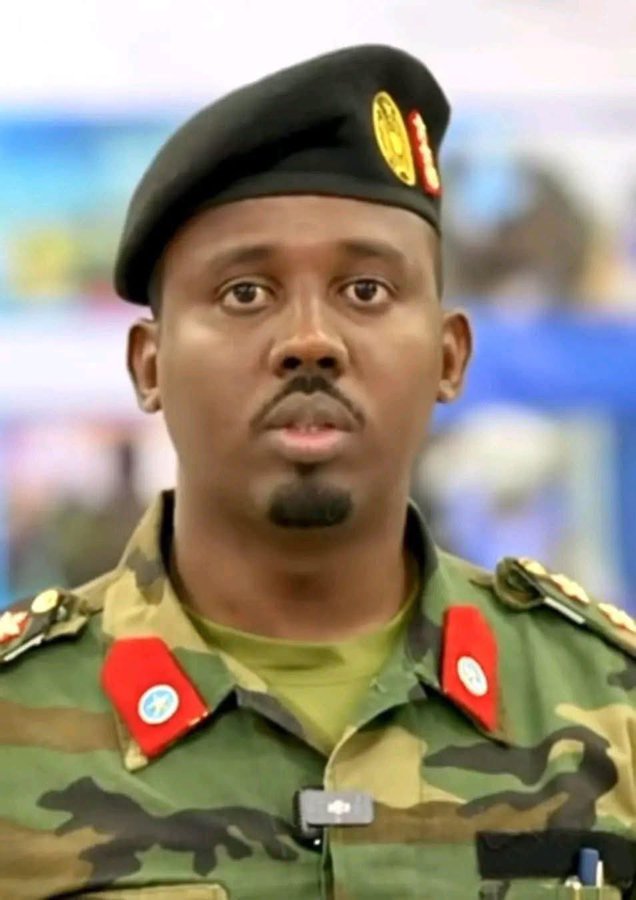
GOOBJOOG NEWS|MOGADISHU: The appointment of Brigadier General Ibrahim Mohamed Mohamud as Chief of the Somali National Army comes at a moment when military reform and renewed counter-insurgency operations are advancing in parallel. The decision, formalised by President Hassan Sheikh Mohamud, places an officer with extensive staff, logistics, and planning experience at the head of an army still in transition.
Brigadier General Mohamud, 36, represents a generation of Somali officers shaped less by the pre-1991 military tradition and more by the long process of rebuilding national security institutions amid insurgency, political fragmentation, and sustained international engagement. His career path, moving between field command, headquarters administration, and multinational planning roles, offers insight into the type of leadership the federal government is prioritising as it enters a new phase of the war.
Academic and Professional Preparation
Brigadier General Mohamud was born in Mogadishu in 1989. He holds a bachelor’s degree in public administration from Mogadishu University and a master’s degree in political science and international relations from Sabahattin Zaim University in Turkey. His academic training has been complemented by professional military education in Somalia, Turkey, Kenya, Uganda, and Rwanda.
Key among these are staff college training at the Turkish Defence University, where he also earned a master’s qualification in security sciences, and regional courses in integrated mission planning and senior mission leadership. These qualifications place him among a limited group of Somali officers with formal grounding in both security policy and operational planning across multinational environments.
Command, Staff, and Institutional Roles
Brigadier General Mohamud’s military career began with company-level command in both field and academy settings, followed by leadership roles at the Somali National Army Academy, where he was responsible for cadet training and battalion discipline. He later moved into operational planning roles, including service at the Somali National Army–AMISOM Joint Operations and Coordination Centre, where he represented Somali headquarters during joint operational planning.
From 2018 onward, his postings increasingly focused on institutional management. As Deputy Chief of Personnel, he worked on human resource systems, personnel readiness, and force tracking. He later served as Chief of Finance at army headquarters, overseeing budget preparation, fiscal management, and financial accountability at a time when payroll integrity and transparency were central concerns for both the government and international partners.
In 2024, following a restructuring of the Somali National Army command architecture, Brigadier General Mohamud was appointed to lead the newly established General Support and Sustainment Command. The restructuring created specialised commands responsible for training, intelligence, special forces, and support functions, and was presented by the government as an effort to improve organisational efficiency and operational coordination. His appointment to the sustainment portfolio was publicly announced as part of that restructuring, underscoring the growing emphasis on logistics, mobility, and operational support in current military planning.
Before assuming his current post, he also served in Nairobi as Chief of Staff of the Eastern Africa Standby Force Planning Element, contributing to regional force planning, doctrine development, and mission design.
Reform Pressures Within the Somali National Army
The Somali National Army today is more structured than it was a decade ago, but it remains under strain. Federal authorities, with international backing, have invested in biometric registration, salary reform, clearer command chains, and the gradual consolidation of regional forces. These measures have reduced some long-standing vulnerabilities, though uneven readiness, logistics gaps, and reliance on external enablers persist.
Placing an officer whose career has spanned personnel management, finance, logistics, and joint planning at the head of the army reflects these realities. Sustaining operations, maintaining discipline, and enforcing institutional standards remain as critical as battlefield manoeuvre.
Preparing for the Next Phase of the Conflict
Brigadier General Mohamud assumes command as the government prepares for a renewed wave of military operations in central and southern Somalia. Over the past two years, Somali forces, working alongside local allies and international partners, have reclaimed territory and disrupted elements of the insurgent group Al-Shabaab. While these operations have weakened the group’s reach in some areas, it retains the capacity to mount attacks and exploit governance gaps.
The next phase of operations is expected to test the army’s ability to sustain pressure over extended periods. Coordination between combat units, logistics chains, intelligence assets, and partner forces will be central to whether gains can be held. Brigadier General Ibrahim’s recent experience overseeing sustainment functions places him at the centre of these operational demands.
Elections and the Security Imperative
The leadership transition also comes as Somalia approaches elections expected in May, a period that has historically placed added strain on the country’s security institutions. Ensuring a stable environment for political processes, public movement, and electoral administration will be a critical test for the Somali National Army. In that context, coherent military leadership and reliable command structures are viewed as essential to preventing security disruptions, particularly in urban centres and contested regions.
Political Context
For President Hassan Sheikh Mohamud, the appointment fits within a broader effort to frame military reform and the fight against Al-Shabaab as core priorities of his administration. The government has argued that recent security gains reflect a more structured approach to both operations and command. Critics, however, continue to caution that reform remains incomplete and vulnerable to political and resource pressures.
By elevating an officer whose career has unfolded largely within technical and institutional roles, the administration avoids overtly personalising the military campaign while signalling continuity in its reform agenda.
An Army Still in Transition
Brigadier General Mohamud takes command of an army that is more capable than in the past, but still dependent on sustained reform and partner support. His tenure will likely be assessed not only by operational outcomes, but by whether the institution maintains cohesion under pressure.
His appointment reflects a measured adjustment rather than a symbolic reset. It aligns leadership with the practical demands of reform and war at the same time, as Somalia moves toward another politically and security-sensitive period.