
Completing the Constitutional Journey
Somalia’s Transition from Provisional Governance to Constitutional Certainty
In March 2026, Somalia reached a defining milestone in its modern political history: the finalization of a constitutional framework that had remained provisional since 2012. After more than a decade of technical review, multi-stakeholder consultation, and contested political negotiation, Somalia’s Federal Parliament voted by a decisive two-thirds majority to bring the constitutional process to completion. The moment was the product of sustained collective effort — spanning two administrations, multiple oversight bodies, federal member states, civil society, traditional leaders, and international partners — anchored across the two presidential terms of Hassan Sheikh Mohamud, whose political leadership bookended the entire process.
The completion of the constitution carries profound legal, political, and historical significance. For more than three decades, Somalia struggled to rebuild a functioning state following the collapse of its central government in 1991. The provisional constitution adopted in 2012 served as the legal foundation for re-establishing national institutions and moving beyond the transitional political arrangements that had governed the country since the early 2000s.
Yet from its inception, the 2012 document was never intended to be final. It was explicitly adopted as a provisional framework — a political compromise designed to allow state institutions to function while fundamental questions of governance, federal architecture, and institutional design were resolved through a structured review. Fourteen years later, that review has run its course.
The finalization therefore represents more than a legislative event. It symbolizes the consolidation of Somalia’s constitutional order, the maturation of its federal system, and a critical step in the country’s continuing project of state-building. This article examines the historical background, the institutional actors who drove the process, the political tensions that complicated it, and the significance of what has now been achieved.
Historical Background: The Collapse of the Somali State
Somalia’s modern constitutional history begins with independence in 1960, when the Somali Republic adopted a democratic constitution establishing a parliamentary system of government. That experiment ended abruptly in 1969 when General Mohamed Siad Barre seized power in a military coup, suspended the constitution, and entrenched authoritarian rule for more than two decades.
The Barre regime collapsed in 1991 following years of civil war. With it went the central government, the national army, and the institutional architecture of the Somali state. The country entered a prolonged period of fragmentation, clan-based conflict, and statelessness that would persist for more than two decades.
Through the 1990s and early 2000s, a series of internationally supported transitional arrangements attempted to restore a semblance of national governance:
- The Transitional National Government (TNG), formed in 2000 following the Arta Peace Conference in Djibouti
- The Transitional Federal Government (TFG), established in 2004 under the Nairobi-brokered Mbagathi Agreement
Neither arrangement succeeded in establishing durable state authority. Both rested on temporary charters rather than constitutionally grounded frameworks, and both were hampered by clan rivalries, resource disputes, and the absence of effective territorial control. By the late 2000s, there was broad agreement among Somali leaders and international partners that sustainable governance required a formal constitutional foundation — one that could command broad legitimacy and provide a clear legal architecture for state-building.
That recognition gave rise to the constitutional roadmap that ultimately produced the provisional constitution of 2012.
The Adoption of the Provisional Constitution in 2012
On 1 August 2012, Somalia’s National Constituent Assembly formally adopted the Provisional Constitution of the Federal Republic of Somalia in Mogadishu. The 825-member assembly brought together traditional clan elders, civil society representatives, women’s groups, and regional delegates — a deliberately broad coalition designed to confer popular legitimacy on the document.
The adoption marked a watershed. It ended the era of transitional governance and established the Federal Government of Somalia on a constitutional footing for the first time since 1991. Hassan Sheikh Mohamud was subsequently elected as Somalia’s first non-transitional president, a development that lent the new constitutional order both institutional continuity and political momentum.
The provisional constitution established Somalia as a federal, democratic republic, enshrined fundamental rights, and created the basic architecture of a three-branch government. It was a significant achievement. But it was also, by design, incomplete.
Why the Constitution Was Provisional
The provisional designation was not a formality. It reflected genuine and irreconcilable disagreements among Somali political actors on several foundational questions that could not be resolved in time for the 2012 transition. Rather than allow these disputes to stall the establishment of a federal government altogether, leaders agreed to adopt a working framework and defer the contested issues to a structured review process. The unresolved matters included:
- The final structure of federalism and the number of federal member states
- The distribution of executive, legislative, and fiscal powers between the federal government and federal member states
- The constitutional status and administrative arrangement of Mogadishu as the federal capital
- The design of the electoral system, including whether and when to transition to universal suffrage
- The composition, independence, and jurisdiction of the judiciary, including a constitutional court
Chapter Fifteen of the provisional constitution embedded the review process within the document itself, establishing a legal obligation to address these issues within a defined timeframe. The constitution was thus simultaneously a governing instrument and an unfinished political negotiation.
The Constitutional Review Process: Institutions, Tensions, and Progress
The constitutional review process that followed was neither linear nor straightforward. It was shaped by institutional competition, political disagreements, resource constraints, and shifting governmental priorities. That it ultimately reached completion is a testament to the resilience of the process itself and the commitment of the multiple actors who sustained it across a decade.
The Institutional Architecture
Two principal bodies were established to drive the review:
The Independent Constitutional Review and Implementation Commission (ICRIC) served as the technical engine of the process. Composed of constitutional experts, legal scholars, and specialists in comparative federalism, ICRIC was tasked with reviewing the text of the provisional constitution, developing draft amendments, and producing the technical documentation necessary to inform political decision-making. Its independence was intended to insulate the review from short-term political pressures.
The Parliamentary Oversight Committee (OC) on Constitutional Review functioned as the political counterpart to ICRIC. A joint committee drawn from both houses of the Federal Parliament, it was responsible for overseeing ICRIC’s work, receiving draft amendments, and facilitating the parliamentary deliberations that would ultimately give legal force to constitutional changes. The two bodies were designed to be complementary: ICRIC supplying the technical substance, the OC providing the democratic accountability.
In practice, however, the relationship between these institutions was not always smooth. A significant and at times paralyzing tension emerged between ICRIC and the Ministry of Constitutional Affairs over the question of institutional mandate. The Ministry argued that responsibility for coordinating the constitutional review — including the conduct of stakeholder consultations and public engagement — fell within its governmental remit. ICRIC, as an independent commission, maintained that its mandate was distinct from that of the executive branch and that ministerial control over the process would compromise its integrity. This jurisdictional dispute consumed political capital and introduced delays into the review at critical junctures.
Stakeholder Engagement and Consultation
Notwithstanding these institutional tensions, the review process incorporated extensive mechanisms for public participation. A series of constitutional conferences were convened at the regional level, bringing together representatives of federal member states, traditional clan leaders, women’s organizations, youth groups, diaspora communities, and civil society actors. These consultations served both a substantive purpose — gathering diverse perspectives on contested constitutional questions — and a legitimacy function, ensuring that the eventual constitutional text could claim broader ownership than any single institution could confer.
Federal member states — whose relationship with the federal government lay at the heart of the most contentious constitutional disputes — were engaged throughout the process, though the degree of their constructive participation varied. International partners, including the United Nations Assistance Mission in Somalia (UNSOM), the African Union, and bilateral donors, provided financial, logistical, and technical support that underpinned the process. Their involvement was a necessary condition for sustaining a review of this complexity over such an extended period.
Political Delays and the 2024 Breakthrough
Despite the institutional framework put in place, the constitutional review process was repeatedly interrupted. Changes in government, competing legislative priorities, disagreements over the sequencing of reforms, and the political sensitivity of the core unresolved issues all contributed to delays that stretched the review well beyond its originally envisaged timeline.
A significant breakthrough came in 2024 when the Federal Parliament approved amendments to the first four chapters of the constitution following protracted deliberations. These amendments addressed foundational questions of federal governance architecture and introduced reforms to the electoral framework, including provisions aimed at a phased transition toward universal suffrage. The passage of these amendments was not without controversy: critics — including some opposition parliamentarians and civil society voices — questioned whether the consultation process had been sufficiently inclusive, and whether the pace of reform reflected political expediency more than genuine consensus. These concerns were not universally shared, but they formed part of the legitimate public debate that accompanied the process.
The 2024 amendments nonetheless demonstrated that Somalia’s constitutional institutions were capable of resolving fundamental governance questions through legal processes. They also set the stage for the final phase of the review.
Resolving the Unresolved: What the Finalization Addressed
The finalization of the constitution in 2026 required that the five foundational ambiguities embedded in the 2012 provisional text be addressed with sufficient clarity to allow the document to stand as a permanent framework. While the specific amended articles remain subject to official publication, the constitutional process is achieved resolution in the following areas:
Federal Architecture and Power Distribution
The most contested terrain of the review concerned the structure of federalism itself. The provisional constitution had left deliberately vague the boundaries of federal member states, the allocation of legislative and executive competences, and the fiscal relationship between Mogadishu and the regions. The finalized constitution establishes a clearer framework for the distribution of powers, defining exclusive federal competences, concurrent powers, and the residual authority of federal member states. It also addresses the revenue-sharing arrangements that had been a persistent flashpoint in federal-regional relations.
The Status of Mogadishu
The constitutional status of Mogadishu — simultaneously Somalia’s capital city and the seat of a putative Benadir regional administration — had generated political tension throughout the review period. The finalized text provides a clearer framework for Mogadishu’s governance, resolving the ambiguity between its status as a federal district and its relationship to surrounding regional structures.
Electoral System
The provisional constitution had deferred the question of when and how Somalia would transition from its clan-based indirect electoral system to universal suffrage. The 2024 amendments began addressing this question; the finalized constitution enshrines a roadmap for that transition, establishing the legal basis for future elections conducted on the basis of one person, one vote.
The Judiciary and Constitutional Court
The provisional constitution provided only a skeletal framework for the judiciary and made no provision for the establishment of a functioning constitutional court — an institution essential for adjudicating disputes between federal and regional governments. The finalized text addresses the composition, appointment process, and jurisdiction of the constitutional court, providing the legal foundation for an institution that Somalia has, in practice, lacked throughout the provisional period.
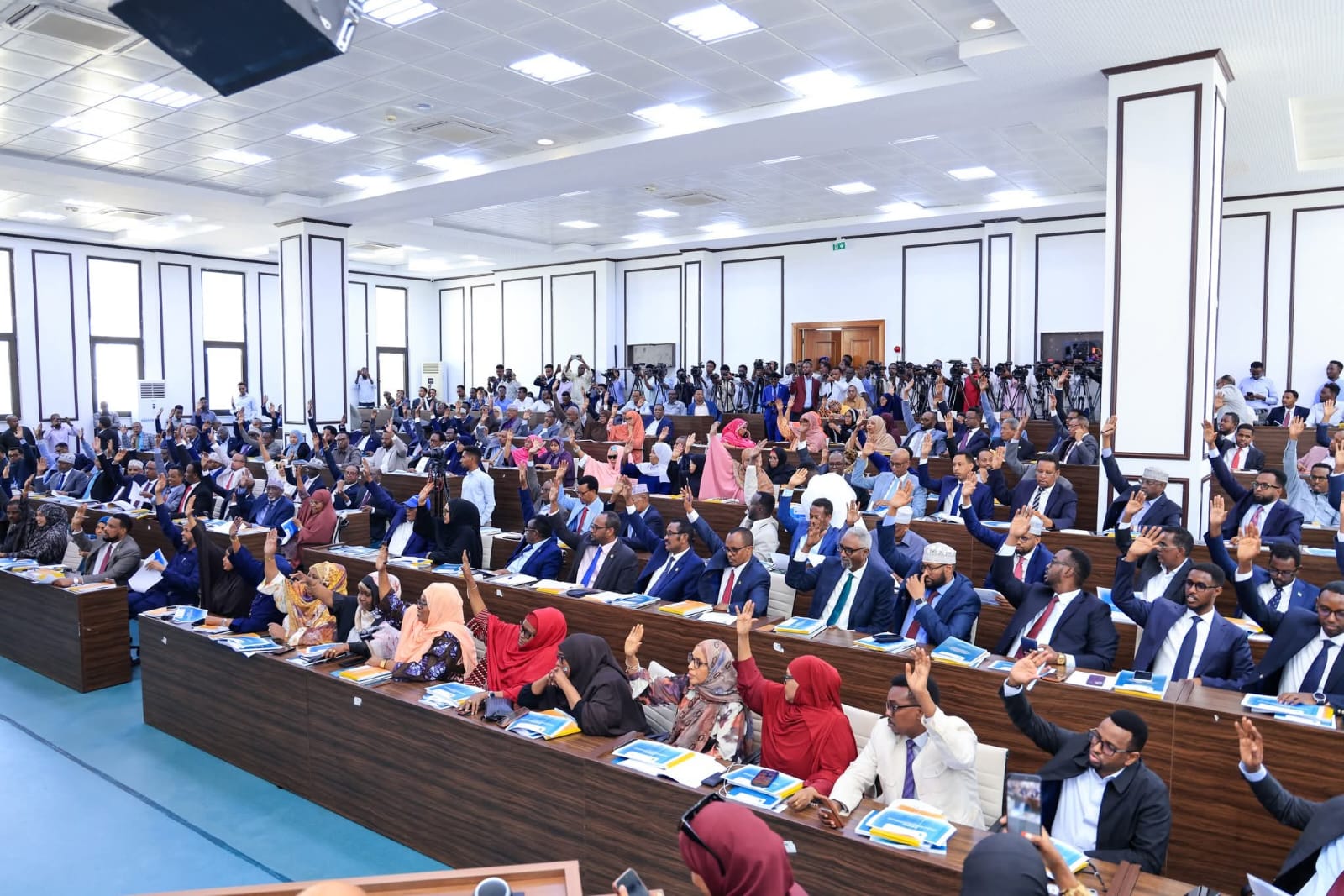
The Vote of 4 March 2026
On 4 March 2026, Somalia’s Federal Parliament convened in joint session to consider the final constitutional amendments. The vote — 222 members in favour, meeting and exceeding the required two-thirds threshold — brought to a formal close the process that Chapter Fifteen of the 2012 provisional constitution had mandated. The provisional designation, carried for fourteen years, was extinguished.
President Hassan Sheikh Mohamud, whose political career has been uniquely intertwined with Somalia’s constitutional history, described the occasion as a historic milestone. The characterization is defensible: it was Mohamud’s first administration that presided over the adoption of the provisional constitution in 2012, and his second administration that saw the process through to completion. His continuity across both moments gives him a legitimate claim to significance in this history, though that significance is most accurately understood as stewardship rather than sole authorship of an outcome that required the sustained effort of many actors over many years.
Legal Significance of the Constitutional Completion
From a legal perspective, the finalization of the constitution strengthens Somalia’s constitutional order in several interconnected ways.
Constitutional Certainty
The provisional constitution’s defining characteristic was its incompleteness. Numerous provisions were explicitly temporary; others were left deliberately ambiguous to paper over political disagreements. A permanent constitution eliminates this ambiguity, providing a stable legal text against which the actions of government can be measured and, where necessary, challenged.
Institutional Authority
State institutions derive their authority from the constitutional order within which they operate. A finalized constitution strengthens the legal grounding of the presidency, the parliament, the courts, and the institutions of federal member states. It also provides a more robust framework for resolving institutional disputes — including the perennial tensions between the federal government and the regions — through legal rather than political channels.
Constitutional Supremacy and the Rule of Law
The constitution is the supreme law of Somalia. All legislation, executive action, and governmental conduct must conform to its provisions. By resolving the ambiguities of the provisional text, the finalized constitution strengthens the practical enforceability of this supremacy. It also establishes the constitutional court on firmer footing, providing an institution capable of giving constitutional supremacy operational meaning.
International Standing
A permanent constitutional framework carries weight in Somalia’s relationships with international partners, bilateral donors, international financial institutions, and the broader community of states. Constitutional stability is a recognized marker of institutional maturity and a signal that the foundations for sustained engagement are in place.
Political Significance
Beyond its legal implications, the completion of the constitution carries political significance on several levels.
It represents the consolidation of Somalia’s federal political order. The structure of federalism had been the most contentious unresolved question since 2012, generating recurring tensions between Mogadishu and the regions. A constitutionally grounded federal framework does not eliminate those tensions, but it provides a more durable basis for managing them.
It also signals the definitive end of the transitional era. Somalia has operated under some form of transitional or provisional arrangement for more than two decades. The completion of the constitution is the legal and symbolic moment at which that era closes. The country now governs itself under a permanent constitutional framework — for the first time since 1969.
Finally, it strengthens the legitimacy of democratic institutions at a moment when that legitimacy matters. Political systems function more effectively when the rules governing them are clear, settled, and widely accepted. By resolving long-standing constitutional ambiguities, Somalia’s institutions are better positioned to focus on the governance, service delivery, and security challenges that remain.
These achievements should be assessed with appropriate realism. A finalized constitutional text does not automatically translate into the effective governance it describes. Implementation — of the federal framework, the electoral system, the constitutional court, and the wider institutional architecture — will require sustained political will, institutional capacity, and resources that Somalia is still working to consolidate. The constitution is a framework, not a guarantee.
Conclusion: A Framework, Not a Finish Line
The completion of Somalia’s constitution in March 2026 is one of the most consequential developments in the country’s modern political history. What began in 2012 as a provisional framework — a carefully constructed compromise designed to stabilize a state still emerging from conflict — has become a permanent constitutional order. The fourteen-year journey between those two points was neither smooth nor inevitable. It required the sustained engagement of constitutional experts in ICRIC, the oversight and deliberation of parliamentary committees, the participation of civil society and traditional leaders, the financial and technical support of international partners, and the political will of successive governments to keep an imperfect process moving forward.
That the process was bookended by the presidential terms of Hassan Sheikh Mohamud is a historical fact of significance. His first administration laid the constitutional foundation in 2012; his second brought it to completion. That continuity is meaningful. But it is most accurately read as the continuity of a national project — one in which the presidency was a central actor, but by no means the only one.
Somalia’s transition from provisional to permanent governance is not only a legal milestone. It is a signal of national resilience — evidence that a state which lost its constitutional foundations entirely in 1991 has, through decades of painstaking effort, rebuilt them. The harder work of giving those foundations meaning through effective, accountable, and responsive governance now begins.