
Fano, TPLF And OLA Join New Seven-Group Alliance Against Ethiopia Government
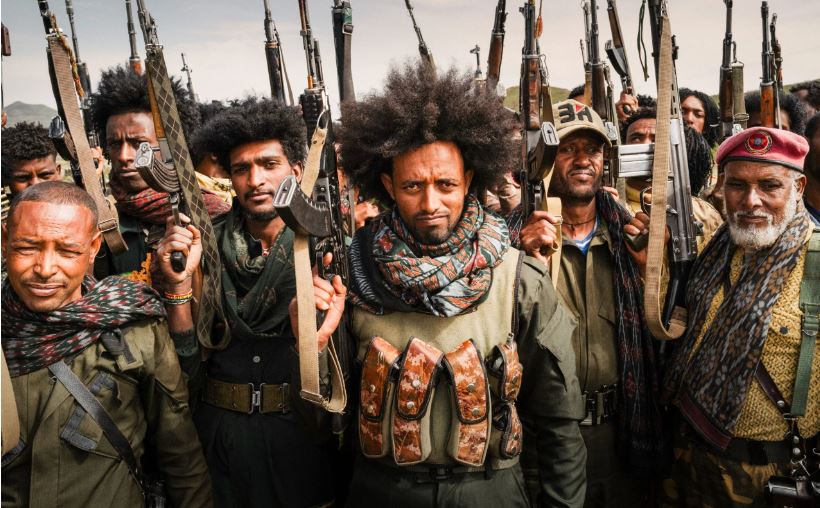
GOOBJOOG NEWS| ADDIS ABABA: Seven Ethiopian armed and opposition groups, including forces that fought on opposing sides during the devastating Tigray war, have formally established a new alliance aimed at removing Prime Minister Abiy Ahmed’s Prosperity Party government and establishing a transitional administration.
The Ethiopian Peoples’ Forces Alliance for Survival was announced on September 20 by Amhara Fano National Movement (AFNM) chairman Zemene Kassie, bringing together the AFNM, Tigray People’s Liberation Front (TPLF), Oromo Liberation Army (OLA), Ogaden National Liberation Front (ONLF) and three other regional groups.
The alliance also includes the Afar Revolutionary Democratic Unity Front, also known as Uguugumo, the Benishangul Peoples’ Liberation Movement and the Gumuz Peoples’ Democratic Movement.
In its founding statement, the alliance said its immediate objective was to coordinate its members’ political and organisational capabilities to remove the Prosperity Party government and establish what it described as an inclusive transitional administration governed by a Transitional Charter.
The groups accused the government of failing to end Ethiopia’s conflicts and address deteriorating political, economic and humanitarian conditions. The federal government has previously rejected similar accusations from armed opposition groups.
The alliance said a proposed transitional administration would seek to end ongoing wars, restore security and law and order, guarantee human and democratic rights, address economic and social crises and improve Ethiopia’s relations with neighbouring countries.
It also proposed an inclusive constitutional dialogue following a political transition, saying fundamental disagreements over Ethiopia’s political system and relations among its different communities should ultimately be addressed through public participation and a legal process.
The formation of the alliance is significant because it formally brings together several groups with sharply different political histories, territorial claims and, in some cases, records of fighting against one another.
Fano forces fought alongside Ethiopia’s federal military against the TPLF during the 2020-2022 Tigray war. That conflict ended with the Pretoria peace agreement in November 2022, but relations between Fano and the federal government subsequently deteriorated.
Large-scale fighting between federal forces and Fano erupted in the Amhara region in 2023 following moves by the federal government to integrate regional special forces into other security structures. The conflict has continued despite military operations by federal forces.
The TPLF, meanwhile, dominated Ethiopia’s ruling coalition for nearly three decades before Prime Minister Abiy came to power in 2018. It subsequently fought federal forces and their allies in the two-year Tigray war.
Relations between the TPLF and Addis Ababa have again deteriorated amid disputes surrounding implementation of the Pretoria agreement and renewed security tensions in northern Ethiopia.
The inclusion of the Oromo Liberation Army further broadens the geographical reach of the new coalition. The OLA has been fighting federal forces primarily in Oromia, Ethiopia’s most populous region.
The alliance therefore brings together opposition forces with bases or political constituencies stretching from Tigray and Amhara in northern Ethiopia to Oromia, the Somali region, Afar and Benishangul-Gumuz.
However, the announcement does not by itself establish that the seven organisations have created a unified military command or resolved longstanding political and territorial disagreements among themselves.
Those differences are particularly significant between Fano and the TPLF. Amhara forces and Tigrayan authorities remain divided over contested territories in western and southern Tigray, one of the unresolved issues left after the 2020-2022 war.
The new alliance said its members had agreed to resolve their differences peacefully on the basis of what it described as the freely expressed will of Ethiopia’s peoples and through lawful processes.
It also called on other political organisations, civic groups and opposition forces that support its objectives to join the coalition.
In a particularly sensitive appeal, the alliance urged members and commanders of Ethiopia’s federal security forces to abandon the government and join its campaign.
It also appealed to neighbouring countries, other African governments and the wider international community for support, presenting its campaign as an effort to achieve political change, democracy and peace in Ethiopia.
The federal government had not issued a formal response to the alliance’s September 20 announcement at the time of reporting.
The emergence of the coalition adds another dimension to Ethiopia’s increasingly complex security landscape, with armed conflicts and political tensions affecting several parts of the country.
Its longer-term significance will depend partly on whether groups that have historically pursued different and sometimes competing political objectives can translate their newly announced cooperation into a durable political framework, particularly while fundamental disputes over territory, federalism and Ethiopia’s future constitutional order remain unresolved.