
From Provisionality to Constitutional Order: Somalia’s Constitutional Completionand the Continuing Reconstruction of the State
By Abdirahman Abshir Mohamed
For more than a decade, Somalia has governed under a constitutional framework
deliberately described as provisional. The Provisional Constitution adopted in 2012
served a vital purpose in the aftermath of state collapse: it provided the legal
foundation upon which national institutions could be rebuilt after more than two
decades of conflict and institutional fragmentation.
Yet from its inception, the document was understood to be transitional. Several of its chapters were subject to future review, and key elements of the federal system were left deliberately open to negotiation as Somalia’s political institutions matured.
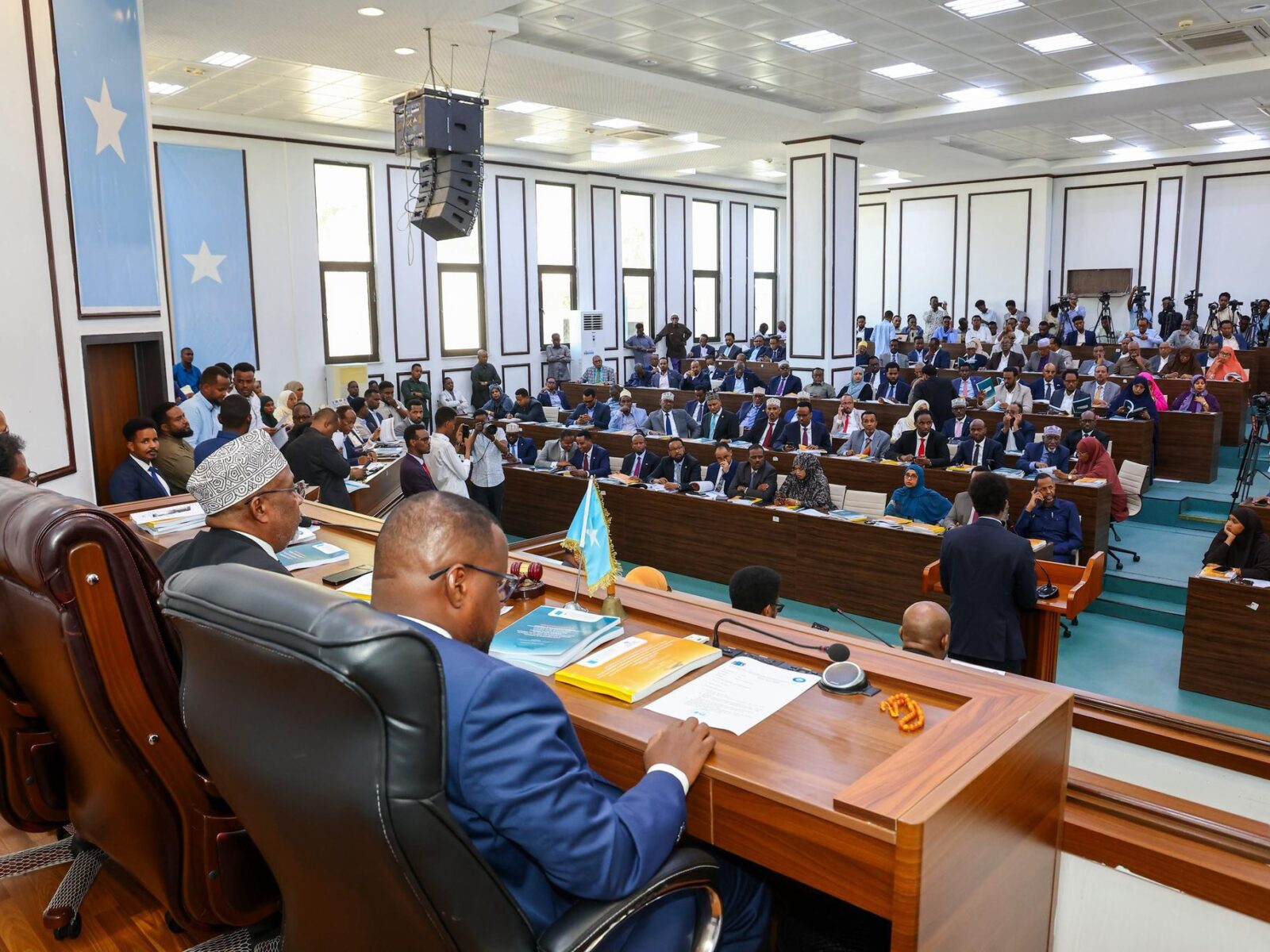
The recent approval by Somalia’s Federal Parliament of the final constitutional
amendments therefore represents an important constitutional moment in the
country’s modern political history. After fourteen years of review across successive
governments, legislatures, and consultative forums, Somalia has moved beyond the
provisional phase of its constitutional order. The amendments clarify the structure of
federal governance, refine the allocation of powers between institutions, and provide
a more coherent legal architecture for the Somali state.
This transition is not merely the conclusion of a legislative process. It represents the
maturation of Somalia’s constitutional reconstruction and the consolidation of a legal
framework capable of supporting long-term governance.
Somalia’s Constitutional Journey
Somalia’s constitutional history has followed a complex trajectory shaped by
independence, centralization, collapse, and reconstruction.
The first Somali constitution was adopted in 1960 following the union of the former
British Somaliland Protectorate and the Trust Territory of Somalia administered by
Italy. That constitution established a parliamentary republic and was widely
considered among the more democratic constitutional systems in post-colonial Africa.
The military takeover of 1969 marked the beginning of a second constitutional phase,
culminating in the 1979 constitution under the Somali Democratic Republic. Although
the constitution formally maintained institutional structures, governance became
increasingly centralized within the executive.
The collapse of the Somali state in 1991 effectively suspended constitutional
governance. For more than a decade Somalia lacked a functioning national
constitutional order and instead relied on transitional political arrangements
negotiated through regional and international peace processes.
The Transitional Federal Charter adopted in 2004 marked the beginning of Somalia’s
modern constitutional reconstruction. It introduced federalism as a framework for
rebuilding the Somali state while acknowledging the emergence of regional
governance structures during the years of state collapse.
The 2012 Provisional Constitution represented the next decisive step. It restored
permanent national institutions and created the Federal Government of Somalia.
However, the document intentionally left several institutional questions unresolved,
including the detailed allocation of powers within the federal system and the
constitutional status of local government.
The amendments now adopted by the Federal Parliament complete that constitutional
review process and clarify many of the structural issues that remained open.
Federalism as the Architecture of State Reconstruction
Federalism has been at the center of Somalia’s state-building project since the early
stages of constitutional reconstruction. In the aftermath of state collapse, a return to a
highly centralized political system was widely viewed as politically untenable.
Federalism offered a framework capable of reconciling national unity with regional
autonomy.
Yet federal systems require careful constitutional design. Without clear institutional
rules governing relations between levels of government, federal arrangements can
become a source of political instability rather than a mechanism for managing
diversity.
The constitutional amendments contribute to addressing this challenge by clarifying
Somalia’s federal architecture. The constitution now explicitly recognizes three levels
of government: the Federal Government, the Federal Member States, and local
governments. The formal constitutional recognition of local government is significant.
It reinforces the principle that governance in a federal system should operate as close
to citizens as possible while remaining integrated within the broader constitutional
order.
This approach mirrors developments in several other constitutional systems across
Africa. Kenya’s 2010 constitution, for example, created a system of devolved county
governments designed to bring public authority closer to citizens while maintaining
a strong national constitutional framework. Similarly, South Africa’s post-apartheid
constitution established a system of cooperative governance between national,
provincial, and local institutions.
Somalia’s constitutional reforms reflect a similar recognition that sustainable
governance requires both national cohesion and decentralized authority.
Allocating Powers in the Federation
Perhaps the most structurally important aspect of the amendments is the development
of a clearer framework for allocating powers within the federation.
The constitution now distinguishes between exclusive federal powers, shared powers
exercised jointly by federal and state institutions, powers reserved to Federal Member
States, and powers belonging to local governments. It also addresses residual powers
and the delegation of authority between levels of government.
Such a classification of powers is a hallmark of mature federal systems. In Germany,
India, and Ethiopia, for example, constitutional schedules clearly distinguish federal
and regional competencies in order to minimize jurisdictional conflict.
In the Somali context, this clarification is particularly significant.
During the early years of federal governance, disputes over jurisdiction between federal and state institutions often created political tensions and continue to so. A clearer constitutional allocation of powers provides a legal framework through which such disputes can be resolved through constitutional interpretation rather than political confrontation.
For legal practitioners within government institutions, including those working in the
areas of diplomacy and treaty law, the clarification of constitutional authority is
equally important. International agreements, development partnerships, and crossborder
cooperation must all operate within the constitutional structure of the state. A
more clearly defined federal framework strengthens the ability of the Somali state to
ensure that its international engagements are consistent with domestic constitutional
law.
Strengthening Federal Institutions
The amendments also enhance the institutional role of the Upper House of the Federal
Parliament. In federal systems, second chambers often function as mechanisms for
representing the interests of constituent units within national governance.
Somalia’s Upper House now plays a more prominent role in overseeing federal-state
relations, participating in the formation of Federal Member States, and contributing
to the resolution of disputes between different levels of government.
This development reflects a broader principle of federal governance: stability within
a federation requires institutions capable of mediating between national authority and
regional representation.
The Constitutional Status of the Capital
The governance of Mogadishu has long occupied a complex place within Somalia’s
constitutional debates. As the seat of national government, the capital performs
functions that extend beyond those of a typical municipality.
The revised constitutional provisions provide a clearer framework for the governance
of Mogadishu and the Banaadir region. The amendments recognize a representative
local administration while maintaining the Federal Government’s responsibility for
matters of national significance within the capital including its security.
This arrangement resembles models found in several other federal systems. Cities
such as Washington, D.C., Abuja, and Brasília operate under special constitutional
arrangements reflecting their dual roles as municipal jurisdictions and seats of
national government.
Clarifying the governance of the capital therefore contributes to the broader effort to
stabilize Somalia’s institutional architecture.
Constitutional Order and International Legitimacy
The consolidation of Somalia’s constitutional framework carries significance beyond
domestic governance. Constitutional stability is also an important dimension of
international legal legitimacy.
Within the international system, states derive not only sovereignty but also credibility
from the existence of stable constitutional institutions capable of exercising authority
within defined legal frameworks. For countries emerging from prolonged conflict or
institutional disruption, the establishment of a coherent constitutional order is often
an essential step in rebuilding international confidence.
Somalia’s constitutional completion therefore strengthens the country’s capacity to
engage with international partners, participate in regional organizations, and fulfill its
obligations under international law.
For institutions responsible for managing the country’s international legal
engagements, including treaty negotiation and implementation, a clearer
constitutional framework reinforces the principle that Somalia’s external relations are
anchored in a stable system of domestic law.
From Constitutional Completion to Constitutional Practice
The completion of Somalia’s constitutional review process does not resolve every
political question facing the country. Federal-state relations will continue to evolve,
electoral reforms will require continued institutional development, and the
implementation of constitutional provisions will demand sustained legislative and
administrative effort.
Yet the importance of this moment lies in the transition from a constitutional
framework defined by provisional arrangements to one grounded in a more stable
legal order.
Across Africa and beyond, the endurance of constitutional systems ultimately
depends not only on the text of the constitution but also on the political culture that
develops around it. Constitutional governance requires institutions willing to operate
within the limits of law and political actors committed to resolving disputes through
constitutional mechanisms.
Somalia now enters that phase of its constitutional journey.
The Constitutional Debate and the Question of Legitimacy
No constitutional transition occurs without contestation. Somalia’s constitutional
amendments have been no exception. Critics of the process, including some
parliamentarians and leaders from certain Federal Member States, have argued that
the amendments were adopted without sufficient consultation, that parliamentary
procedures were flawed, and that the process risks upsetting the delicate federal
balance established in 2012.
In federal constitutional systems, legitimacy does not arise solely from the adoption
of legal texts; it also depends on whether citizens and political actors believe the
constitutional order reflects a broadly shared national compact. Debate and
disagreement over constitutional reform are therefore not signs of constitutional
failure but of constitutional politics itself.
However, it is important to distinguish between political disagreement with
constitutional outcomes and claims that constitutional procedures themselves were
violated. The Somali constitutional review process did not occur outside the
constitutional framework. It was conducted through institutions explicitly mandated
by the constitution itself: the Independent Constitutional Review and Implementation
Commission (ICRIC), the Parliamentary Oversight Committee on Constitutional
Review, and ultimately the Federal Parliament, which retains the authority to amend
the constitution through the procedures established within the constitutional text.
Federal constitutions across the world, from India to Ethiopia and from South Africa
to Germany, allow constitutional amendments to proceed even in the presence of
political disagreement among constituent units.
Federal consensus is politically desirable, but it is rarely unanimous. Constitutional law therefore relies on institutional procedures rather than absolute unanimity as the mechanism through which constitutional change becomes legally valid.
In Somalia’s case, the constitutional amendments were debated over multiple
parliamentary terms and were ultimately approved by the Federal Parliament in
accordance with the amendment procedures provided within the constitutional
framework. While political actors may dispute aspects of the process, the legal
authority to amend the constitution rests with the institutions designated by the
constitution itself.
For this reason, claims that the amendments represent a wholesale violation of
constitutional law risk conflating political opposition with constitutional illegality.
Constitutional systems are designed precisely to provide lawful procedures through
which disagreement can be resolved within institutions rather than outside them.
Federal Consensus and Constitutional Practice
A second line of criticism asserts that the constitutional amendments lack legitimacy
because some Federal Member States chose not to participate in parts of the process.
This argument raises an important question about the nature of federal constitutional
change.
In federations around the world, constitutional amendments often proceed despite
disagreement among constituent units. The adoption of Kenya’s 2010 Constitution,
Ethiopia’s federal constitution in 1995, and South Africa’s post-apartheid constitution
in 1996 all occurred amid intense political disagreements among different actors
within those states. Yet constitutional systems cannot require unanimous consent for
every institutional reform without effectively rendering constitutional change
impossible.
Somalia’s constitutional framework recognizes this reality. While federal consultation
is an essential component of constitutional politics, the constitution ultimately vests
amendment authority in the Federal Parliament. The Upper House, representing
Federal Member States, forms part of this legislative structure precisely to ensure that
federal interests are incorporated into national constitutional decision-making.
The absence of some political actors from particular stages of the process is therefore
politically significant, but it does not automatically invalidate the constitutional
authority of the institutions that carried the process forward.
More importantly, constitutional systems are not static settlements but evolving
political orders. Federal-state relations in Somalia will continue to evolve through
political negotiation, legislation, judicial interpretation, and institutional practice. The
constitutional amendments should therefore be seen not as the final word on federal
governance but as a framework within which future dialogue and adjustment will
continue.
Constitutionalism Beyond the Moment of Adoption
Ultimately, the legitimacy of any constitution is not determined solely at the moment
it is adopted. It is determined over time through the way institutions operate under it.
Across the world, constitutional systems gain legitimacy through consistent
application of constitutional rules, peaceful resolution of disputes through legal
institutions, and the gradual development of political practices that respect
constitutional limits.
Somalia’s constitutional completion therefore marks not the end of constitutional
debate but the beginning of a new phase in which the constitution will be tested
through practice. Federal institutions will interpret and apply its provisions, courts
will adjudicate constitutional disputes, and political actors will continue to negotiate
the evolving balance between federal and state authority.
In this sense, constitutional legitimacy is ultimately a product of constitutional
practice.
Somalia’s constitutional order, like those of many other states emerging from conflict
or political transformation, will mature through time. The amendments adopted by
the Federal Parliament provide a clearer institutional framework within which that
maturation can occur.
Lastly, it is worth noting that after decades in which the Somali state was defined by
transitional arrangements and institutional uncertainty, Somalia has now crossed an
important constitutional threshold. The provisional framework that guided the early
years of reconstruction has now given way to a more settled constitutional order.
The task ahead is not merely to defend the constitution as a legal document, but to
ensure that it becomes the durable foundation of Somalia’s democratic and federal
governance.
Goobjoog News is committed to publishing a diversity of letters to the editor or any other article of interest to our readers. We’d be glad to hear what you think about this article or any other article in our opinion sections.
Abdirahman Abshir Mohamed is Director of the Legal and Treaties Department at the Ministry of Foreign Affairs and International Cooperation of the Federal Republic of Somalia. He previously served as a legal officer and researcher at the Supreme Court of Somalia.