
Iran Begins State Funeral for Supreme Leader Khamenei
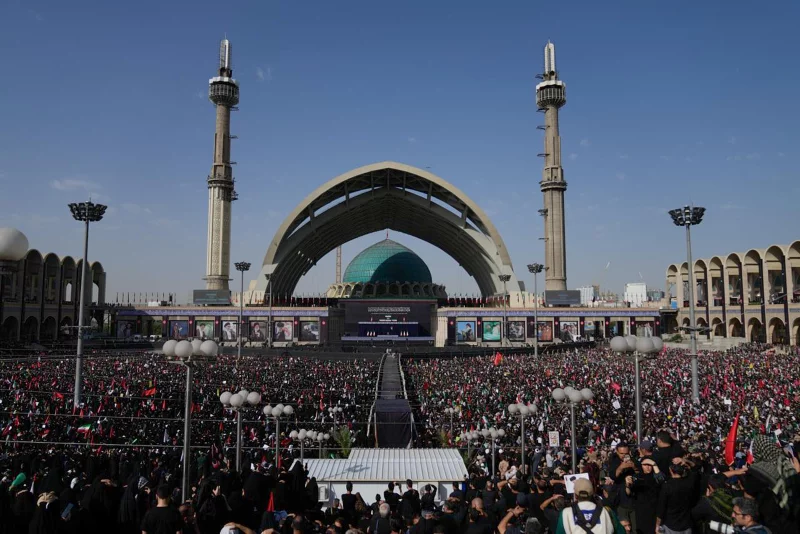
GOOBJOOG NEWS | TEHRAN: Iran on Saturday began a week-long state funeral for Supreme Leader Ayatollah Ali Khamenei, drawing tens of thousands of mourners to Tehran in a solemn display of national grief following the death of the country’s longest-serving leader in a U.S.-Israeli airstrike earlier this year.
Khamenei, who led the Islamic Republic for nearly four decades, was killed on February 28 during the opening stages of the 12-day conflict between Iran and Israel that drew direct U.S. military involvement and marked one of the most dangerous escalations in the Middle East in decades.
His casket, draped in the Iranian flag and topped with his signature black turban, was placed on display at Tehran’s Grand Mosalla mosque, where mourners queued to pay their final respects. Crowds chanted slogans in support of the Islamic Republic, while religious leaders led prayers during the opening ceremony. Authorities expect millions of people to participate in funeral processions scheduled to take place in Tehran, Qom and the holy city of Mashhad over the coming days.
The funeral is expected to be one of the largest state ceremonies in Iran since the burial of Ayatollah Ruhollah Khomeini, the founder of the Islamic Republic, in 1989. Security has been tightened across the capital, with thousands of police and Revolutionary Guard personnel deployed to protect the ceremonies.
The ceremonies come at a pivotal moment for Iran, which is navigating both a leadership transition and the aftermath of a conflict that caused widespread destruction and further strained relations with the United States and Israel. While a ceasefire has largely held, diplomatic efforts aimed at securing a broader agreement over Iran’s nuclear programme and regional security remain fragile.
Foreign delegations from several countries, including Russia, China, Iraq and Pakistan, are expected to attend parts of the funeral, reflecting Iran’s continuing diplomatic ties despite heightened tensions with Western governments.
Khamenei became Iran’s Supreme Leader in 1989 following the death of Ayatollah Khomeini and oversaw some of the country’s most consequential political and geopolitical developments, including the expansion of Iran’s regional influence, prolonged tensions with the West, negotiations over its nuclear programme and successive rounds of international sanctions. As Supreme Leader, he held ultimate authority over Iran’s armed forces, judiciary and key state institutions.
His death has ushered in a new chapter for the Islamic Republic, with Iranian leaders seeking to project stability while confronting mounting economic pressures, regional uncertainty and questions over the country’s future political direction. Observers say the coming weeks will be closely watched for signs of how Tehran intends to navigate its domestic transition and relations with the international community.