
Israeli Recognition: A Travesty of International Law and a Lone Ranger’s Odyssey
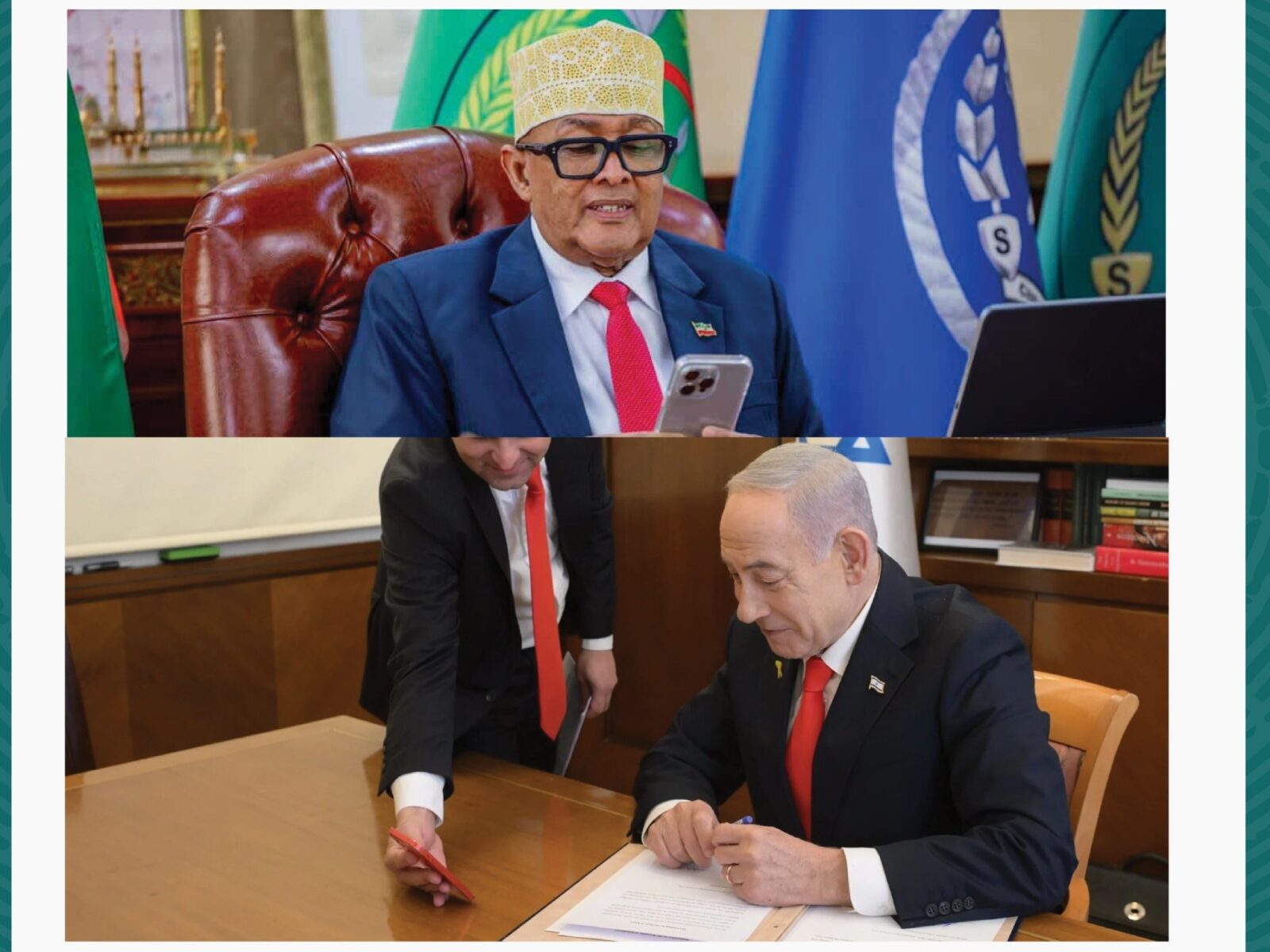
The Israeli government announced on Friday that it was formally recognizing the north-west regions of Somalia – Somaliland as an independent sovereign state formally breaking the long held international stance on Somalia’s statehood. Effectively, Israel became the only UN member state to make such a declaration in the backdrop of international isolation following its genocidal policy in Palestine.
The Somali government, countries in the region and beyond including key continental blocs such as the African Union, IGAD, Gulf Council Commission and the League of Arab States have strongly condemned the move, warned of regional instability and declared the move a nullity. Even U.S. President Donald Trump has dismissed the idea with a ‘No!” to his close ally Prime Minister Benjamin Netanyahu.
This article examines the international law position, contemporary international practice and consequences of Israel’s unilateral action against a part of Somalia’s international recognized territory. Recognition is an exercise in international law upon which sovereign states come into being. It is not just a symbolic act of pronouncement but it carries with it legal weight and diplomatic ramifications for all parties concerned.
International Law Context
Whereas recognition is a sovereign act by states, it is not an exercise in isolation; it is regulated by international law. Two schools of thought have sought to explain the concept of recognition albeit with shortcomings. Declaratory theorists argue that states exist by a matter of fact, not permission. They argue that as long as they meet the objective criteria- permanent population, defined territory, an effective government and the capacity to conduct foreign relations as outlined in the Montevideo Convention of 1933, recognition just merely acknowledges an existing fact. But this thinking does not acknowledge secession as a possible path to statehood.
Constitutive theorists on the other hand build their case on the fact of recognition. That states come into being and gain legitimacy through recognition-especially by a sizeable number of countries. It follows therefore that break-away regions like Somaliland can exist as de facto states despite lacking international legal identity. But this theory lends immense unchecked political power to states turning recognition into a tool of influence on international law.
But international law does not necessarily accede to these theoretical thoughts. It is pragmatic and alive to the parameters of international legal instruments such as the UN Charter, AU Constitutive Act and other relevant aspects such as territorial integrity and as far as the consent of the parent state.
Remedial Secession: Somaliland Question
While international law appears to be neutral, it is averse to secession unless in instances where certain strict criteria is met. Framers of international law were careful not to create a legal carte blanche where member states would go on a fishing expedition for selfish national interests as the case with Israel in Somaliland. They located territorial integrity of existing states as the default rule. Proponents of the Somaliland secession cite what scholars have termed as ‘remedial secession’ which applies as last resort to escape grave human rights violations, systematic oppression, or the persistent denial of internal self-determination. This was the case in Bangladesh- then East Pakistan in 1971 when it faced severe linguistic, economic, and political discrimination from West Pakistan. In 2008, Kosovo declared independence from Serbia citing systematic oppression and ethnic cleansing by Serbian forces in the late 1990s of its Albanian ethnic population. Although the International Court of Justice in its advisory opinion in 2010 did not find Kosovo to have breached international law, it did not endorse the primacy of ‘remedial secession’ in international law.
In effect therefore, ‘remedial secession’ has not been established as a rule of customary international law. In the case of Somaliland, some argue that the human rights abuses and atrocities reported during the late 1980s and early 1990s under the military regime of Siad Barre could justify claims for recognition or independence from Somalia. However, these violations were not confined to the northwestern regions; rather, they were part of a broader, systematic pattern of state repression affecting multiple regions and communities across Somalia. Today, Somaliland maintains social, political, and economic interactions within the wider Somali framework where key federal political positions such as the chief justice, the Speaker of the Senate and deputy prime minister of Somalia have traditionally been allocated to representatives from Somaliland, alongside other established political arrangements.
Consent From Parent State
As argued earlier, international law and modern practice have established guardrails against geopolitical expeditions as we are now witnessing in the Red Sea and Horn of African regions. Whereas the Montevideo nor other international law instruments do not expressly provide for consent from parent states in the case of recognition, it still remains crucial in providing the ‘constitutive ease’ to legal independence. Such was the case in Eritrea (1993) after conflict and internationally supervised plebiscite and South Sudan (2011) also through a referendum and negotiated settlement. Without consent therefore, member states will need to consider territorial integrity as a foundation of the UN Charter thus cautious in recognising break-away regions. That could explain why Israel might be on a lonely ranger mission as other countries will not want to violate Somalia’s territorial fidelity. It follows therefore that for Somaliland; there is no negotiated settlement with Somalia and neither has there been an internationally recognised referendum. Mogadishu has neither given the node.
The African Union Position
The Constitutive Act of the African Union expressly maintains the status quo on borders inherited from the colonial administrations. This was not a lazy approach to the boundary question as some have alluded; it was a pragmatic approach to a quagmire which post independent Africa found itself. A revisionist approach would have unravelled the whole continent and opened the proverbial ‘pandora’s box’ leading to endless conflicts. As such therefore, the Cairo Declaration (1964) pronounced itself unequivocally on territorial integrity, sovereignty and non-interference.
Some observers have however made reference to the 2005 AU Fact Finding Mission to Somaliland as recommending a pathway to statehood. In reality, the Mission acknowledged the Somaliland governance but did not make any recommendation on recognition. The AU has also subsequently referred all matters of Somaliland status to dialogue with the Federal Government of Somalia.
Israeli Recognition-Why It Is Weak
From the foregoing, it is clear that Israel is acting outside all norms-international law, contemporary practice and common sense. While a debate of Netanyahu’s aspiration (which are clearly at play-from describing it a Mossad mission to the Gaza debacle) is not within the remit of this article, it is worth pointing that this is act in isolation. He has taken unilateral decisions outside international law and practices with the net effect of heralding tensions in the Horn of Africa and the Red Sea region.
Conclusion
There is no denial that the aspirations of Somaliland are real. To deny this is to forget the perilous lessons of history. However, recognition is a collective legal process which must undergo negotiated settlement not unilateral acts as Netanyahu has purported to.