
Liban’s Election Marks Major Institutional Transformation in Galmudug’s State-Building Journey
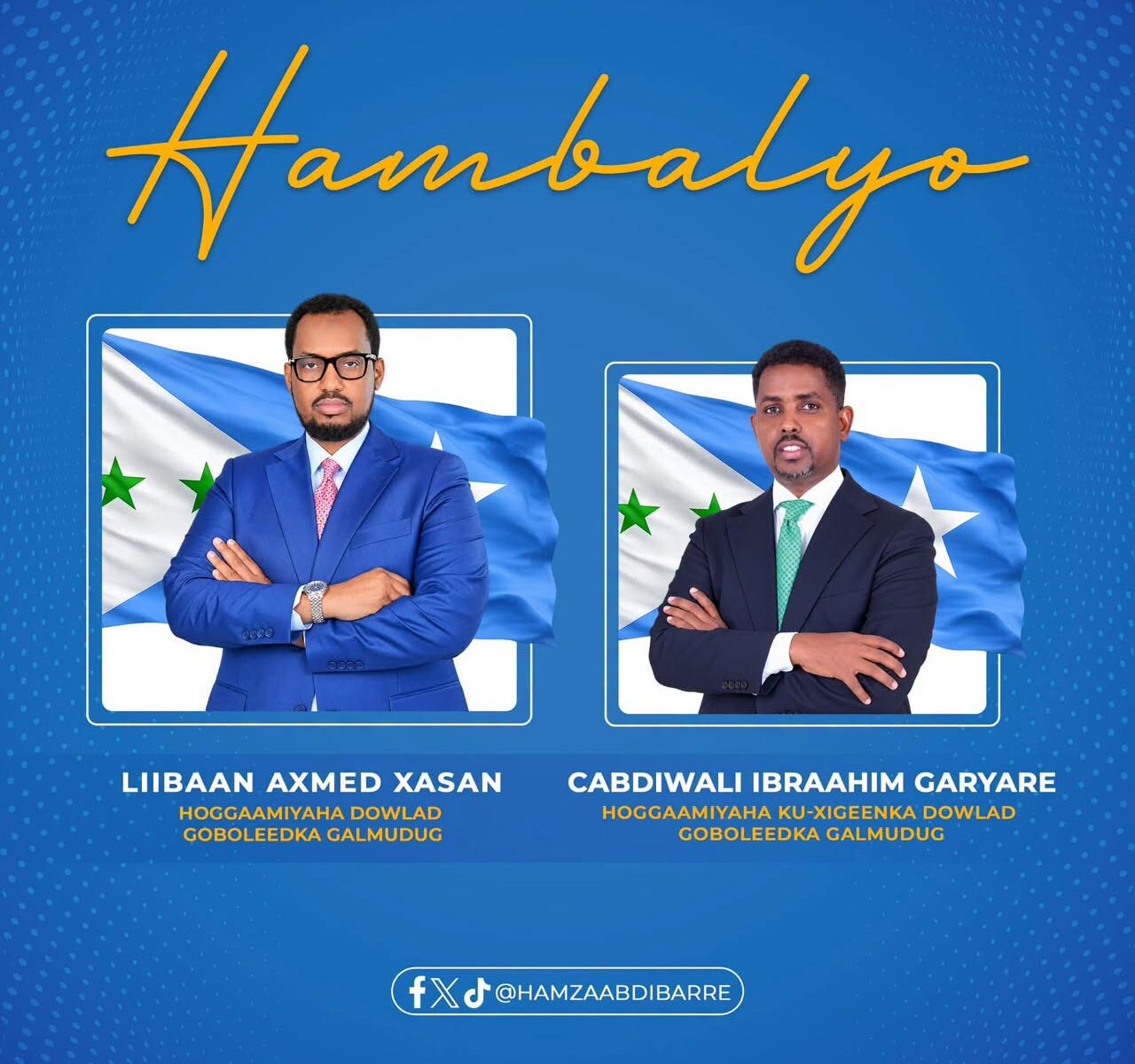
GOOBJOOG NEWS|DHUSAMAREEB: The election of Liban Ahmed Hassan as Galmudug’s new leader marks a significant milestone in the federal member state’s institutional transformation, opening a new chapter in the decade-long effort to rebuild functioning state institutions in central Somalia after years of conflict, political fragmentation and competing centres of authority.
Liban, the candidate of the Justice and Solidarity Party (JSP), secured 72 of the 89 ballots cast by members of the Galmudug State Assembly, defeating Abdulkadir Abdullahi Diriye of Sincad, who received 14 votes. Three ballots were declared invalid, giving him a decisive first-round victory.
Lawmakers also elected Abdiweli Ibrahim Aden Garyare as deputy leader after he secured 64 votes against 20 for his opponent, Abdisatar Mohamed Gelle.
Beyond the emergence of a new political leadership, the elections represent a broader institutional transition in Galmudug, where political representation has evolved from arrangements negotiated among clan elders, armed groups and political factions towards a system incorporating direct voter participation, political organisations and elected representatives.
The leadership vote followed direct elections for the State Assembly, marking a significant departure from the indirect, clan-based arrangements that have historically determined political representation in Galmudug.
The transition is particularly significant for a federal member state whose formation and subsequent political development have been characterised by disputes over territorial administration, clan representation, political legitimacy and the distribution of power.
It also represents another step in Somalia’s wider federal state-building process, particularly in central regions where successive attempts to establish unified political authority have faced resistance from competing administrations, armed movements and entrenched local interests.
From Cadaado to Dhusamareb: A Decade of Political Transformation
Galmudug’s current federal-era administration emerged from the Cadaado state-formation process in 2015, when political leaders and clan representatives sought to establish a unified administration covering Galgaduud and parts of Mudug.
The process was intended to bring competing political interests under a common institutional framework, but disagreements over political representation, territorial authority and the location of government institutions continued to shape the state’s early years.
Abdikarim Hussein Guled became the first leader of the post-2015 administration, serving until 2017. However, his government struggled to establish effective authority across the state’s territory, particularly in Dhusamareb, which remained under the control of the Sufi-oriented Islamist movement Ahlu Sunna Waljama’a (ASWJ).
The group had emerged as an influential military and political force after confronting Al-Shabaab’s expansion in central Somalia. Although it opposed the militant organisation, ASWJ remained outside the Galmudug administration established in Cadaado, maintaining separate political and security structures.
The resulting divisions created competing centres of authority, complicating efforts to establish a unified government and consolidate the state’s administrative institutions.
Guled’s successor, Ahmed Duale Gelle, widely known as Haaf, inherited these disputes when he assumed office in 2017.
His administration pursued reconciliation with ASWJ, eventually leading to negotiations facilitated by the Intergovernmental Authority on Development (IGAD), the regional organisation representing countries in the Horn of Africa.
Following talks in Nairobi and Djibouti, the two sides reached a power-sharing agreement in December 2017 aimed at integrating their parallel political, administrative and security institutions.
Under the agreement, ASWJ leader Sheikh Mohamed Shakir was allocated the newly established position of chief minister, while arrangements were made to incorporate the movement into the state assembly, administration and security structures.
The settlement also helped pave the way for the relocation of Galmudug’s government institutions from Cadaado to Dhusamareb, which had been designated the state capital during the 2015 formation process but remained outside the administration’s effective control.
The agreement represented a major political breakthrough, bringing together two competing authorities whose rivalry had undermined efforts to establish a functioning regional government.
However, its implementation also generated fresh disagreements over power-sharing and political representation. Some political actors opposed the arrangement, while tensions between ASWJ and other stakeholders subsequently resurfaced, demonstrating the fragility of negotiated political settlements.
The agreement nevertheless marked an important stage in Galmudug’s institutional evolution by advancing the integration of previously competing authorities and reinforcing Dhusamareb’s position as the centre of state administration.
Ahmed Abdi Kariye, known as Qoorqoor, assumed office in 2020 amid continuing political tensions. His administration oversaw further institutional development, local-government initiatives and military operations against Al-Shabaab, although disagreements involving ASWJ periodically threatened stability.
Liban now becomes the fourth leader of Galmudug’s post-2015 federal-era administration, inheriting institutions that have developed considerably since the Cadaado conference but continue to face challenges of political inclusion, insecurity and limited administrative capacity.
The latest elections therefore represent more than a routine leadership transition. They mark another stage in the gradual shift from political arrangements negotiated among competing groups towards a more structured system of electoral representation and institutional governance.
Galmudug’s Strategic Importance in the War Against Al-Shabaab
Beyond its political transformation, Galmudug occupies a strategically important position in Somalia’s continuing military campaign against Al-Shabaab.
Located across central Somalia, the state connects several regions of the country and encompasses important transport corridors linking southern and northern Somalia, as well as inland communities and coastal areas.
Its geographical position has made it a critical theatre in efforts to contain Al-Shabaab’s territorial influence, disrupt its movement between regions and prevent the expansion of its operations into northern Somalia.
For years, parts of Galgaduud and Mudug have served as battlegrounds between government forces, allied local militias and Al-Shabaab fighters.
The emergence of ASWJ as an armed movement opposed to Al-Shabaab helped restrict the militant group’s expansion into parts of central Somalia before the establishment of the current Galmudug administration.
More recently, Galmudug became a major focus of federal government-led military operations, particularly during the offensives launched in late 2022 and 2023 with the participation of local community forces commonly known as Ma’awisley.
Those operations targeted longstanding Al-Shabaab strongholds and supply routes across Mudug and Galgaduud, including areas around Harardheere, Galcad, Ceel Buur and Galhareeri.
The campaign resulted in the recovery of several strategic locations, although subsequent militant counterattacks and withdrawals by government forces demonstrated the difficulties of maintaining control over contested territory.
In August 2023, President Hassan Sheikh Mohamud temporarily based himself in Dhusamareb to oversee efforts to intensify the military campaign, underscoring Galmudug’s importance to the federal government’s wider security strategy.
The state remains strategically significant not only because of the territory contested by Al-Shabaab but also because of the role of local communities, traditional leaders and regional authorities in supporting military operations.
Cooperation between federal forces, Galmudug security institutions and local fighters has been an important component of counterinsurgency efforts, particularly in areas where community resistance has challenged Al-Shabaab’s influence.
However, military gains have repeatedly highlighted the need for functioning local administrations, effective security arrangements and public services in areas recovered from the militants.
Without those institutions, the withdrawal or redeployment of security forces can leave communities vulnerable to renewed attacks and the re-establishment of militant influence.
For the incoming Liban administration, strengthening cooperation with the federal government while addressing local political and clan grievances will therefore be central to sustaining security gains.
The state’s political stability has direct implications for Somalia’s wider counterinsurgency campaign. A cohesive Galmudug administration could strengthen coordination and support efforts to prevent Al-Shabaab from exploiting divisions among communities and political actors.
A Strong Parliamentary Mandate
Liban assumes office with a commanding parliamentary majority.
His party, JSP, secured 67 of the State Assembly’s 89 seats, giving it a substantial advantage ahead of the leadership election. His eventual tally of 72 votes indicates that he attracted support beyond the party’s parliamentary bloc.
That majority provides the incoming administration with considerable legislative backing as it prepares to establish a cabinet, formulate development priorities and implement its political programme.
It could also facilitate decision-making and reduce some of the political deadlock that affected previous administrations.
However, the concentration of parliamentary power within one political organisation will place greater responsibility on the new leadership to protect institutional checks and balances, accommodate minority political voices and ensure that government decisions reflect the interests of communities beyond the governing party.
The challenge will be to transform electoral dominance into broader public legitimacy rather than allow the parliamentary majority to become a substitute for political consultation.
Reconciliation and Security Among Immediate Priorities
Despite the institutional progress, Galmudug continues to face substantial security and governance challenges.
Al-Shabaab remains a threat in parts of Galgaduud and Mudug, particularly in rural areas where limited government presence and difficult terrain complicate security operations and civilian administration.
Recurrent clan disputes, often linked to land, grazing resources, water access and longstanding grievances, also continue to undermine stability and restrict economic activity.
During his campaign, Liban pledged to initiate an inclusive reconciliation process within his first 100 days in office, bringing together political stakeholders, traditional elders and communities affected by unresolved disputes.
The initiative could become an early test of his administration’s ability to address divisions that have repeatedly challenged Galmudug’s stability.
The history of the IGAD-supported settlement between Haaf’s administration and ASWJ offers an important lesson. Political agreements can create opportunities for institutional integration, but their durability depends on sustained consultation, equitable representation and the willingness of competing actors to resolve disputes through established institutions.
For Liban, reconciliation will be particularly important in areas where political competition, clan tensions and insecurity overlap, limiting the government’s ability to establish effective administrative structures.
Beyond security, the new administration faces growing expectations for improved public services, stronger district institutions, road infrastructure, water supply, livestock markets and employment opportunities.
For many residents, the significance of institutional transformation will ultimately be measured not by the number of elections conducted or institutions established, but by whether government authority produces meaningful improvements in everyday life.
Turning Electoral Progress Into Lasting Statehood
The latest political transition marks a notable point in Galmudug’s evolution from a state-building project assembled through political negotiation into an administration increasingly organised around electoral and representative institutions.
It is also a reminder that rebuilding state authority in central Somalia remains an unfinished process.
The Cadaado conference established the foundations of the current federal-era administration. The IGAD-supported reconciliation between Haaf’s government and ASWJ helped advance the integration of competing political authorities and the consolidation of Dhusamareb as the seat of government.
Subsequent efforts to expand local administration and confront Al-Shabaab further demonstrated the relationship between political stability, territorial security and effective governance.
The latest elections add another institutional dimension by linking popular participation, legislative representation and executive leadership.
For Liban and Garyare, the immediate challenge will be to consolidate these gains while ensuring that political institutions function beyond the capital and across communities with different political and security experiences.
Their administration will also have to demonstrate that the electoral transition can withstand future political competition and leadership changes without returning to the institutional disputes that characterised earlier periods.
The significance of Galmudug’s transformation extends beyond its own borders. As a central battleground in the campaign against Al-Shabaab and an important component of Somalia’s federal system, its political stability and institutional development have implications for national security and the wider reconstruction of the Somali state.
From the founding conference in Cadaado in 2015, through the IGAD-mediated reconciliation and the consolidation of Dhusamareb as the administrative capital, to the latest elections, Galmudug’s political journey has been shaped by repeated attempts to overcome fragmentation and establish functioning state authority.
Liban’s election has completed another stage of that journey. The next test is whether his administration can translate its commanding parliamentary mandate into inclusive governance, sustained security gains and stronger institutions capable of delivering lasting stability in central Somalia.