
President Mohamud Calls For UN Reform, Direct Elections And Sustained Security Support For Somalia
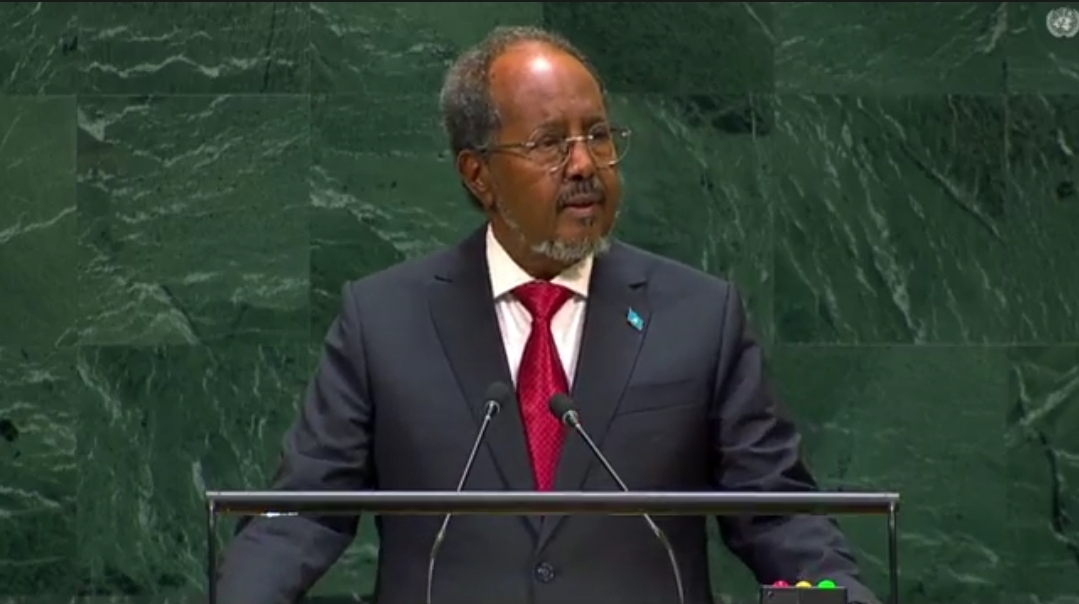
GOOBJOOG NEWS|NEW YORK:Somali President Hassan Sheikh Mohamud has called for sweeping reforms of the United Nations and international financial system while defending his government’s push for direct elections and seeking sustained international support for Somalia’s security transition.
Addressing the 81st session of the United Nations General Assembly in New York on Thursday, Hassan Sheikh said weakening multilateral cooperation, geopolitical rivalry, conflict and climate change were putting growing pressure on the international system.
The president said the UN Security Council should become more representative, transparent and effective, arguing that Africa’s lack of permanent representation remained a “historical injustice” affecting 54 countries. Somalia supports the Common African Position, which seeks greater African representation in both permanent and non-permanent categories of the council.
Somalia is currently serving as a non-permanent member of the Security Council and also sits on the African Union Peace and Security Council. Hassan Sheikh said the country would use the positions to promote conflict prevention, cooperation between the AU and UN and African-led approaches to peace and security.
He also reiterated Somalia’s support for Palestinian self-determination and a two-state solution based on the 1967 borders.
Turning to UN operations in Somalia, Hassan Sheikh called for a significant change in how international assistance is delivered. He said much of UN assistance continued to flow through parallel structures, fragmented projects and off-budget arrangements, making it difficult for Somali authorities to coordinate resources, measure results and strengthen state institutions.
“Somalia is not calling for the United Nations to withdraw,” the president said, instead calling for a partnership in which Somali institutions lead implementation and international assistance strengthens rather than replaces national systems.
On domestic politics, Hassan Sheikh said his government remained committed to replacing Somalia’s longstanding indirect electoral system with universal suffrage and a multiparty political system.
He said Somalia had not held a national direct election since 1969 and described constitutional reform as laying the foundation for citizens to choose their leaders directly. He said the government had engaged political leaders, federal member states, civil society, women, youth and the diaspora in the transition.
The electoral transition remains politically contested, with disagreements between the federal government and some opposition leaders and federal member states over constitutional changes and the framework for national elections.
On security, Hassan Sheikh said Somalia was strengthening its security institutions, force generation and intelligence capabilities but argued that the campaign against terrorism had implications beyond the country.
He called for “predictable and sustainable” international assistance for Somalia’s security transition, including adequate financing for the African Union mission. He said the transfer of full security responsibility to Somali forces should be properly funded, phased and anchored in capable national institutions.
The president also highlighted the economic impact of disruptions in the Strait of Hormuz. He said Somalia’s heavy dependence on food, fuel and other imports from the Middle East meant disruptions were contributing to rising prices, inflation and higher transport and insurance costs.
Hassan Sheikh said the disruption had contributed to an estimated 40% decline in Somalia’s customs-based domestic revenue, describing freedom of navigation through the strait as critical for vulnerable economies.
On the economy, Hassan Sheikh said Somalia’s real GDP was growing at 3.1% this year despite global shocks. He said the government was strengthening public financial management, expanding domestic revenue and seeking to improve the investment environment while increasing investment in education, health and human capital.
He also called for reform of the international financial architecture, arguing that developing countries need greater access to affordable and timely financing.
Concluding his address, Hassan Sheikh said Somalia was seeking a greater role in global governance while rebuilding its economy and pursuing its political transition, and urged Africa and the wider international community to remain engaged with the country.