
Somalia Enters New Constitutional Era Amid Rejection From Opposition, Some Federal Member States
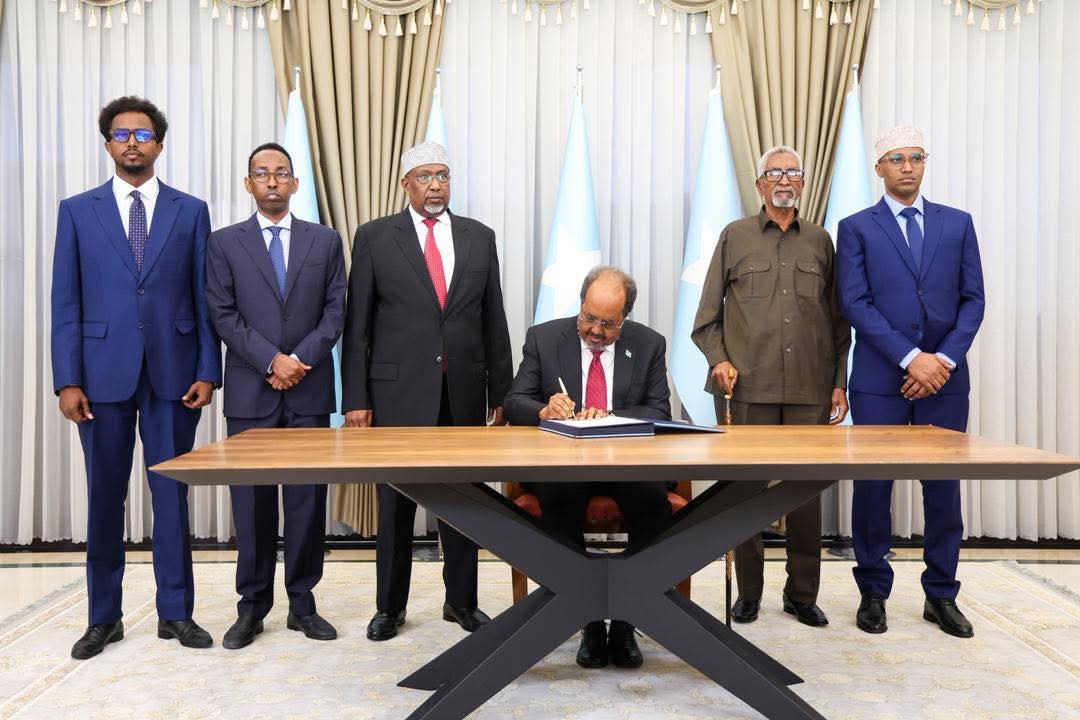
GOOBJOOG NEWS|MOGADISHU: Somalia has formally entered a new constitutional phase after President Hassan Sheikh Mohamud signed amendments to the Constitution of the Federal Republic of Somalia into law, marking what the federal government describes as the end of the country’s provisional constitutional framework that has guided governance since 2012.
In remarks following the signing ceremony, President Mohamud described the development as a historic milestone in the country’s state-building journey.
“Today marks the conclusion of the long journey of reviewing the Constitution of the Federal Republic of Somalia,” the president said, adding that the country would now move forward with implementing the amended constitutional framework.
The amendments were earlier approved by Somalia’s bicameral parliament — the House of the People of the Federal Parliament of Somalia and the Senate of Somalia — after a parliamentary vote that the government says fulfills the constitutional mandate to review and finalize the charter.
However, the transition to what authorities describe as a new constitutional dispensation has been met with strong opposition from key political actors and federal member states.
Somali Future Council Rejects Process
The opposition coalition known as the Somali Future Council has rejected the amendments, arguing that the constitutional review process lacked the political consensus required for altering the country’s supreme law.
Members of the council — which includes several prominent opposition leaders and former senior officials — have criticized the federal government for pushing the changes through parliament without what they describe as adequate consultation with political stakeholders, federal member states, and civil society.
Opposition figures say constitutional reforms of this magnitude should be the result of broad national dialogue rather than parliamentary action alone.
Puntland And Jubaland Also Reject Amendments
The political dispute has been further amplified by the rejection of the amendments by two key federal member states — Puntland and Jubaland.
Authorities in Puntland have stated that they do not recognize the constitutional amendments passed by the federal parliament, arguing that any changes affecting Somalia’s federal structure must be negotiated collectively between the federal government and regional administrations.
Jubaland leaders have expressed similar concerns, warning that unilateral constitutional changes risk undermining the federal political settlement that underpins Somalia’s governance system.
The opposition from these regions reflects longstanding disagreements between Mogadishu and federal member states over the balance of powers within Somalia’s federal system.
End Of The Provisional Constitution Era
Somalia has operated under a Provisional Constitution since August 2012, when it was adopted following the end of the transitional political period and the formation of the Federal Government of Somalia.
The document explicitly provided for a constitutional review process aimed at completing and finalizing key chapters of the charter.
Government officials argue that the amendments and the president’s signature represent the completion of that process and signal Somalia’s transition away from a provisional constitutional framework.
Implementation Amid Political Tensions
Despite the government’s declaration of a new constitutional phase, the rejection from the Somali Future Council and several federal member states suggests that the implementation of the amended charter could face political challenges.
Analysts note that Somalia’s federal system relies heavily on cooperation between the federal government and regional states, meaning that constitutional changes often require broad political agreement to ensure smooth implementation across the country.
For now, the signing of the amended constitution marks a significant institutional step for Somalia, while simultaneously opening a new chapter in the country’s ongoing debate over federalism, political power-sharing, and constitutional governance.