
Somalia Marks End of UN Political Mission After 13 Years as Leaders Reflect on State-Building Journey
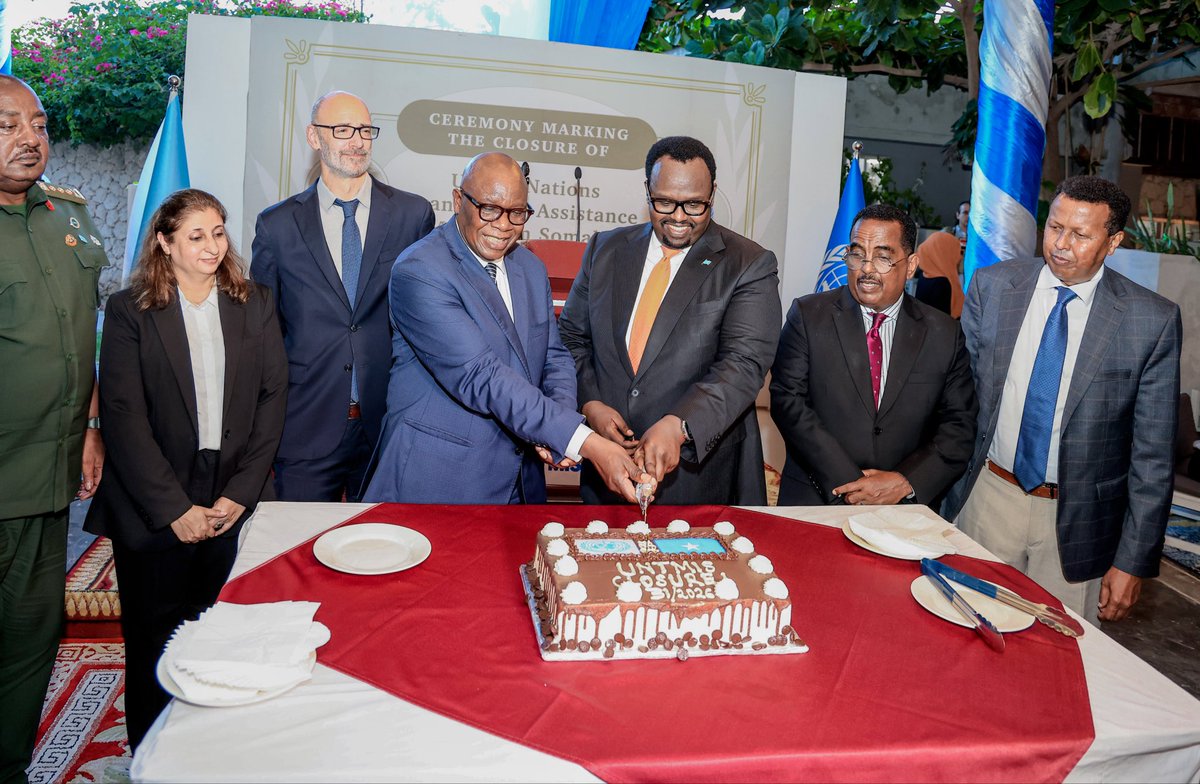
GOOBJOOG NEWS|MOGADISHU: Somalia on Monday marked the end of more than 13 years of United Nations political mission engagement, as government leaders, former senior officials and diplomats gathered in Mogadishu to reflect on the country’s journey from post-conflict reconstruction to the gradual rebuilding of state institutions.
The ceremony marked the closure of the United Nations Transitional Assistance Mission in Somalia (UNTMIS), whose mandate formally expires on October 31, bringing to an end a political mission presence that began with the establishment of the United Nations Assistance Mission in Somalia (UNSOM) in 2013.
Deputy Prime Minister Salah Ahmed Jama, former President Sheikh Sharif Sheikh Ahmed, former Prime Minister Mohamed Hussein Roble and senior UN officials attended the event, alongside diplomats representing the United States, Italy, Türkiye, Sudan and other international partners.
The gathering provided an opportunity to reflect on Somalia’s political and institutional transformation over the past decade, including the development of federal governance structures, electoral institutions, security reforms and efforts to strengthen the rule of law.
Addressing the ceremony, Deputy Prime Minister Jama said Somalia had undergone significant changes since the UN political mission was established, describing its departure as the conclusion of an important chapter in the country’s recovery.
“You are leaving a Somalia that is drastically different from the one that you arrived in,” Jama told UN officials.
He pointed to the development of constitutional and federal institutions, improvements in national security capabilities and economic reforms, including Somalia’s completion of the Heavily Indebted Poor Countries debt relief process.
Jama said the country’s priorities had gradually expanded from rebuilding institutions after decades of conflict to pursuing longer-term economic development, infrastructure investment, climate resilience and opportunities in the blue economy.
However, he acknowledged that the mission’s departure would place greater responsibility on Somali institutions to sustain the progress made over the years.
“For us as the government, we are mindful that the mission has come to an end, but a lot of the work that the mission used to carry out falls on our shoulders,” he said.
UN Assistant Secretary-General and UNTMIS Officer-in-Charge Raisedon Zenenga described the closure as the culmination of a carefully coordinated two-year transition requested by the Federal Government of Somalia and endorsed by the UN Security Council.
Reflecting on the mission’s history, Zenenga highlighted the role played by successive UN political missions in supporting Somalia’s federal system, electoral processes, political dialogue, reconciliation, human rights and the development of justice and security institutions.
Since 2013, the mission has worked alongside successive Somali administrations, Federal Member States, civil society organisations and international partners during some of the country’s most consequential political transitions.
“The closure of UNTMIS does not signal the end of UN support, nor does it diminish Somalia’s partners’ commitment. Instead, it opens a new chapter in the UN’s partnership with Somalia,” Zenenga said.
The establishment of UNSOM in June 2013 followed the conclusion of Somalia’s transitional political arrangements in 2012, when a new federal parliament was inaugurated and Hassan Sheikh Mohamud was elected president for his first term.
Over the following years, the UN mission supported political processes as Somalia worked to establish federal institutions, develop constitutional arrangements and conduct successive indirect elections amid persistent security threats and disagreements between political stakeholders.
The mission also supported reconciliation efforts, human rights monitoring and coordination between Somali authorities and international partners.
In November 2024, UNSOM was succeeded by UNTMIS under a phased transition arrangement designed to conclude the UN’s special political mission presence and transfer responsibilities to Somali institutions and other UN entities.
Ambassador Yusuf Garaad Omar, Somalia’s Special Envoy for the Horn of Africa, Red Sea and Gulf of Aden, said the decision to request the mission’s closure in 2024 reflected the government’s confidence in the country’s institutional development.
“When in 2024 the Federal Government requested the United Nations to bring its Special Political Mission in Somalia to a close, it did so as an expression of confidence—confidence that Somali institutions were ready to assume responsibilities long supported by the international community,” Yusuf Garaad said.
The ambassador, who served as the government’s Co-Chair of the Joint Technical Committee overseeing the transition, said the process involved regular consultations between Somali and UN officials to assess progress, identify risks and coordinate the transfer of responsibilities.
He said the first phase was completed in October 2025, while the second addressed governance, reconciliation, human rights, rule of law, security sector reform and the women, peace and security agenda.
Yusuf Garaad also paid tribute to UN personnel who had served in Somalia, including Raisedon Zenenga, George Conway and former senior UN official James Swan, acknowledging their contributions to the country’s state-building efforts.
George Conway, the UN Deputy Special Representative, Resident and Humanitarian Coordinator for Somalia, said the country’s progress reflected the efforts of Somali leaders, communities and international partners over more than a decade.
“The Somalia of today is not the Somalia of 2013 when UNSOM first deployed to the country,” Conway said.
He reaffirmed that the United Nations would continue supporting Somalia through its humanitarian and development agencies, including programmes addressing resilience, sustainable development and the needs of communities affected by conflict and recurring climate shocks.
“The United Nations remains deeply committed to continuing to work with Somalia in pursuing its national development objectives,” he said.
The closure comes as Somalia continues to confront challenges that have shaped much of the UN mission’s engagement, including the Al-Shabaab insurgency, political disagreements, incomplete constitutional and governance reforms, and strained relations between federal and regional authorities.
Zenenga also welcomed President Hassan Sheikh Mohamud’s recent invitation for political dialogue, underscoring the continuing importance of consensus-building as Somali institutions assume greater responsibility for the country’s political processes.
While the special political mission is ending, the United Nations will maintain its presence through the UN Country Team and other entities, including the United Nations Support Office in Somalia, operating under their respective mandates.
The ceremony concluded with tributes to the Somali and international personnel who served under UNSOM and UNTMIS, marking the end of a 13-year chapter in Somalia’s relationship with the United Nations.
For Somalia, the departure represents both a milestone in its state-building journey and a test of whether national institutions can sustain the political and governance gains achieved over the past decade without a dedicated UN political mission.