
Somalia’s Newly Appointed Supreme Court Chief Sworn In amid Legal Dispute
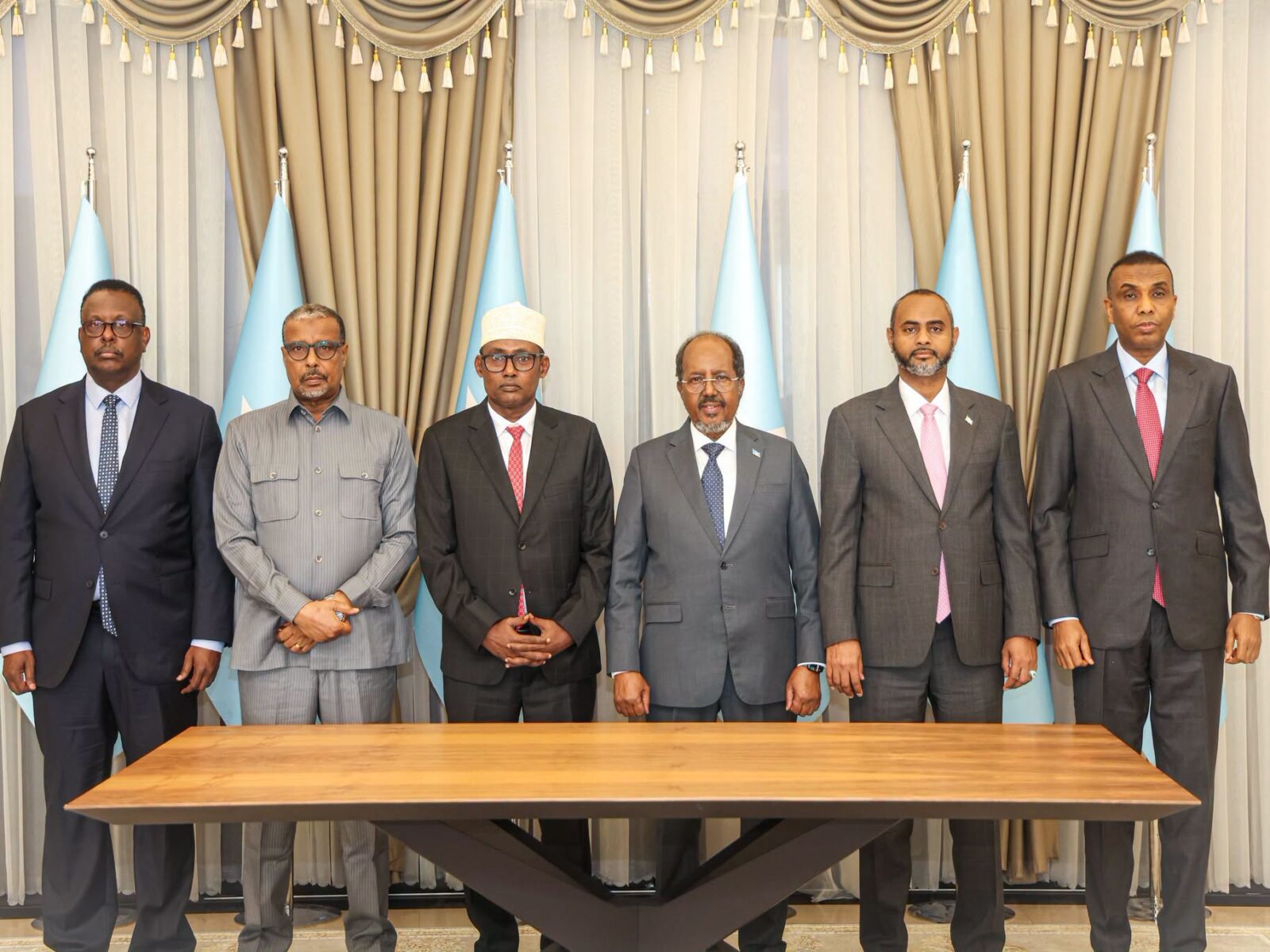
GOOBJOOG NEWS | MOGADISHU: Federal government of Somalia President Hassan Sheikh Mohamud on Saturday presided over the swearing-in of Ibrahim Idle Suleiman as the country’s newly appointed Supreme Court chief justice, amid an escalating dispute over the leadership and constitutional authority of the judiciary.
Suleiman took the oath of office at the presidential palace in Mogadishu after his appointment by President Mohamud, who dismissed incumbent Chief Justice Baashe Yusuf Ahmed earlier this week.
The oath was administered by MP Mohamed Abdirahman Adan, a member of the House of the People’s Committee on Justice, Endowments and Islamic Affairs.
President Mohamud urged Suleiman to discharge his constitutional responsibilities with integrity, transparency and accountability, emphasising the importance of judicial independence, respect for the rule of law and equal access to justice.
The ceremony was attended by Speaker of the House of the People Abdulqadir Mohamed Nur (Jaamac), the First Deputy Speaker of the Upper House, Prime Minister Hamza Abdi Barre and Justice and Constitutional Affairs Minister.
However, Suleiman’s assumption of office comes amid a constitutional confrontation between the presidency and the Supreme Court.
On Thursday, the Supreme Court declared Baashe’s dismissal null and void, arguing that the president lacked the authority to remove the chief justice through the procedure used. The court said the move violated judicial independence and constitutional provisions governing the appointment and removal of the head of the judiciary.
The dispute has unfolded alongside a wider political crisis over constitutional amendments and the mandates of Somalia’s federal institutions.
In a separate ruling on Thursday, the Supreme Court rejected the extension of the current president’s and parliament’s terms, ruling that the constitutional changes adopted earlier this year could not be applied retrospectively to extend the mandates of existing officeholders. It called on political stakeholders to agree on an electoral framework within 30 days and hold elections within 90 days.
The presidency had announced Suleiman’s appointment on Wednesday, citing complaints about the administration of justice and the need for reforms in the judiciary. The Supreme Court’s subsequent rejection of Baashe’s dismissal has, however, left the legality of the leadership change contested.
Suleiman previously served as Somalia’s chief justice before being replaced by Baashe in 2018. His return to the position comes at a critical moment for the country’s judicial institutions, whose role in resolving constitutional and electoral disputes has become increasingly central to the political standoff.