
Why the DRC-Rwanda Peace Deal Matters for East Africa and the Horn
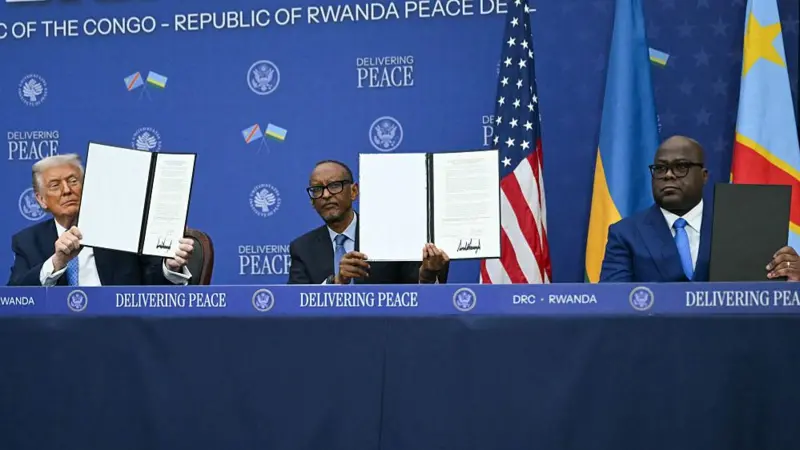
The new peace agreement signed between Democratic Republic of Congo (DRC) and Rwanda does more than offer hope for two war-ravaged neighbours: it carries the potential to reshape regional dynamics across East and Central Africa, with ripple effects even for the Horn of Africa.
For years, conflict in the Great Lakes region has sent shockwaves across borders, through refugee flows, cross-border insecurity, and regional economic instability. A stable, peaceful DRC-Rwanda relationship could ease tension throughout the region, improve trade corridors, and reduce the security burden on neighbouring states.
For East African countries, many of which share trade and security interests with both DRC and Rwanda, that stability can unlock new economic opportunities and allow resources previously devoted to crisis management to be redirected towards development.
A more peaceful Great Lakes region often means fewer arms flows, reduced regional instability, and less pressure on neighbouring states’ security apparatuses. In turn, this may allow governments in the Horn of African, already struggling with internal challenges, to focus more on rebuilding, infrastructure, and long-term development.
Beyond geopolitics, the deal sets a hopeful precedent for conflict resolution in Africa. It is a reminder that diplomacy and negotiation, not perpetual armed conflict, can deliver results.
For recent graduates, youth activists, civil society and media across East Africa, this is evidence that persistent truth-telling, international pressure, and domestic advocacy can lead to real change.
It reinforces the value of civil voice, regional solidarity, and shared responsibility, foundational themes for a stable East Africa.
Of course, the success of any agreement depends on implementation. Skeptics will watch closely to see whether the truce holds, whether displaced populations return, and whether lasting economic integration follows.
Yet, even the act of signing sends a message: in a region too often defined by conflict, peace remains possible.
For the Horn of Africa, this moment should be seen not as distant drama, but as an opportunity. An opportunity to reaffirm the commitment to peace, to deepen regional cooperation, and to build societies not bound by instability, but driven by shared hope, collaboration, and progress.
By Fauxile Kibet