
Somalia’s Long Road to Dialogue: Can New Talks Break the Election Deadlock?
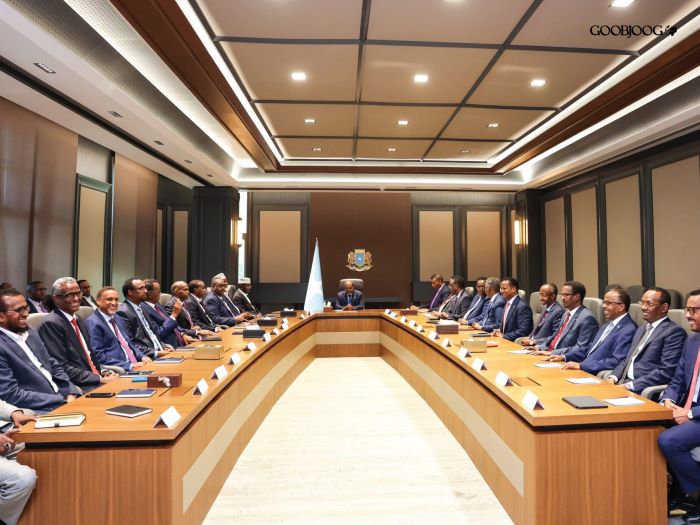
GOOBJOOG NEWS | MOGADISHU: GOOBJOOG NEWS | MOGADISHU: A national political forum called by President Hassan Sheikh Mohamud is scheduled to open in Mogadishu today, Saturday, after months of failed talks and a widening dispute over the country’s leadership and elections. The Presidency says it is consulting invited stakeholders to secure their attendance, though it remains unclear whether the forum will begin as planned.
Talks have failed to bridge the divide
The stand-off sharpened around the end of the president’s term. Under the previous four-year term, Hassan Sheikh’s mandate was due to end on May 15, while parliament’s term expired on April 14. The government says constitutional changes adopted in March extended both terms to five years, keeping the president and lawmakers in office until 2027. The Somali Future Council, an opposition alliance that includes former President Sharif Sheikh Ahmed and the leaders of Puntland and Jubaland, rejects applying the extension to current officeholders.
Negotiations in Mogadishu from May 13 to 15, involving the government, opposition leaders and international mediators, ended without agreement. The main disputes included the government’s push for direct, one-person-one-vote elections and the opposition’s demand for a negotiated framework and assurances over the transition.
Mediation efforts continued in the following months, including UN-backed talks in July. Several rounds of government-opposition discussions in August ended with an agreement to keep talking, but did not resolve the core disagreements. In September, the Somali Future Council called for an international mediation mechanism as the UN political mission that had helped facilitate dialogue prepared to close.
Quartet’s role comes as UNTMIS closes
The United States, United Kingdom, European Union and Turkey—the Quartet—have been reported as helping facilitate the latest round. Their good offices and influence could prove significant if the parties are to move beyond dialogue and secure a political agreement. Opposition figures have previously called for international partners to act as guarantors of any settlement and help ensure it is implemented.
The talks will take place without the UN Transitional Assistance Mission in Somalia (UNTMIS), which ceased operations on October 31 after completing its transition. The closure ended the UN political mission’s established role in supporting political dialogue and mediation in Somalia, leaving the Quartet’s reported involvement especially consequential.
The dispute escalated in October, when the National Independent Elections and Boundaries Commission scheduled parliamentary elections for April 15, 2027, and a presidential election for May 15. Opposition groups rejected the timetable, saying it had not been agreed through inclusive consultations.
On November 5, the Supreme Court ruled that the terms of the president and parliament had expired, rejected the government’s interpretation of the constitutional amendments and called for an election framework to be agreed within 30 days, with elections held within 90 days. The Attorney General rejected the ruling, saying it had no legal effect. The dispute has now extended from politics into a confrontation over the authority of the courts.
The forum is expected to bring together the Somali Future Council, the Nabad iyo Nolol faction led by former President Mohamed Abdullahi Farmaajo, the National Unity Forum and the Civil Society Coalition. Its prospects for progress will depend on whether participants can address the central points of contention: the election model, the legal basis and timeline for the transition, and the terms of an agreement acceptable to both the government and opposition.
After months of talks without a settlement, whether the forum opens as scheduled—and whether key opposition leaders attend—will be an early indication of whether this round can change the course of the dispute.