
U.S. Rules Out a Base in Somaliland, Reaffirms Support for Somali Unity
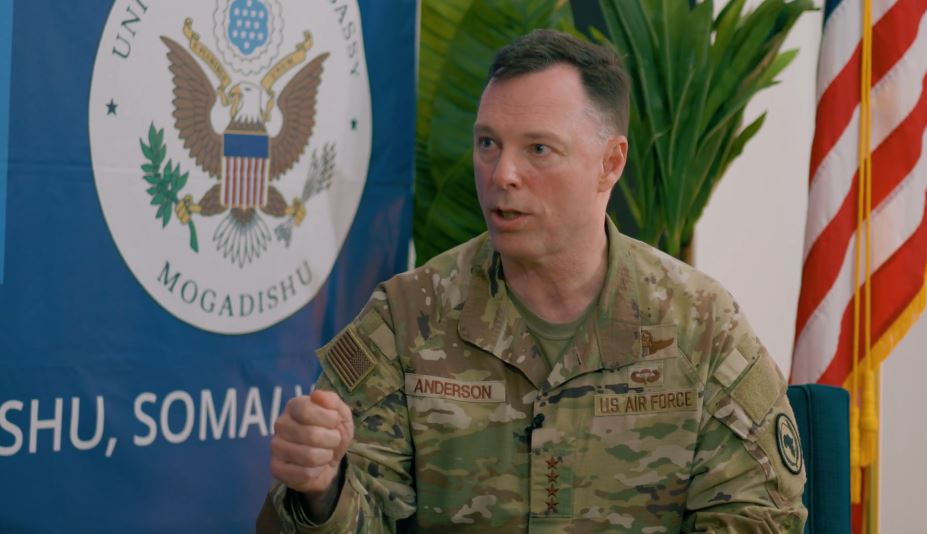
GOOBJOOG NEWS|MOGADISHU: The United States has no plans to build a military base in Somaliland, the new commander of U.S. Africa Command told local media in Mogadishu, a direct answer to speculation that has built for months as American officers made repeated visits to the port city of Berbera.
Gen. Dagvin Anderson was asked about the trips to Hargeisa and Berbera, which have fueled talk that Washington might be preparing to expand its military footprint in the self-declared republic, a territory that has never won formal recognition from the United States or any government beyond Israel.
“There is no plan to build a base in Somaliland,” Anderson said.
Somaliland broke away from Somalia in 1991 after the collapse of the Siad Barre government. It has run its own institutions, currency, security forces and elections for more than three decades without securing membership at the United Nations or an embassy from Washington.
Anderson said American policy on the underlying dispute has not shifted.
“The U.S. policy is and remains the sovereignty and territorial integrity of the Federal Republic of Somalia,” he said.
That single sentence carries more weight now than it might have two years ago. Somaliland’s position on the map, along the Gulf of Aden and within reach of the Bab el-Mandeb Strait, has turned it into one of the more contested pieces of real estate in the region, and outside interest in it has been building from several directions at once.
The clearest sign came in December, when Israel’s prime minister, Benjamin Netanyahu, signed a declaration recognizing Somaliland as an independent state, describing the move as being in the spirit of the Abraham Accords. It made Israel the first country to extend recognition since 1991. Somalia’s government called it an assault on its sovereignty, and the reaction across the region was swift: Egypt, Turkey and Djibouti issued a joint statement backing Somalia’s territorial integrity, protesters marched in Mogadishu, and the matter was taken up at the United Nations Security Council, where several members warned that the move could destabilize an already fragile Horn of Africa.
Reporting since then, including an investigation by the French newspaper Le Monde, has described construction activity near Berbera’s airport that satellite images show intensifying between October 2025 and March of this year, with trenches and underground structures that outside security sources have said resemble fortified storage for fuel or ammunition. That reporting has attributed the project chiefly to the United Arab Emirates, with the possibility that it could eventually serve American and Israeli interests as well. No government, including Somaliland’s own administration, has confirmed the project publicly, and Anderson was not asked about it directly in the interview. His comments addressed only the question of an American base, not the broader pattern of activity that has drawn attention to Berbera.
The interest in Somaliland did not start with Israel’s recognition. Ethiopia, landlocked and long dependent on Djibouti for sea access, signed a memorandum of understanding with Somaliland’s government in January 2024 that would have granted Addis Ababa a 20 kilometer stretch of coastline and, in exchange, raised the prospect of Ethiopian recognition of Somaliland’s independence. Somalia called the deal illegal and nearly severed relations with Addis Ababa over it. Turkish mediation produced the Ankara Declaration in December 2024, under which Ethiopia and Somalia agreed to pursue talks on sea access that would respect Somalia’s sovereignty, but the substance of the original deal was never implemented, and Ethiopia has since looked at other options, including Eritrea’s port of Assab.
Djibouti, for its part, already hosts American, French, Japanese and Chinese military installations, and has watched Berbera’s rise with unease. Analysts who track the Horn of Africa have long argued that Washington’s own interest in diversifying away from Djibouti, where China’s naval base sits a few kilometers from the American one, gives Berbera a strategic logic independent of the Somaliland recognition question altogether.
None of that changes what Anderson said on the record. For Mogadishu, his remarks amount to a public reaffirmation of a position it has long sought from international partners, that security cooperation anywhere in Somalia should not be read as a step toward recognizing the country’s breakup. For Somaliland, which has intensified its diplomatic campaign since Israel’s recognition and has spoken of ambitions to join the Abraham Accords itself, the comments are a reminder that Washington’s official position has not moved, even as the strategic value of its coastline keeps drawing outside powers closer.