
13 Years of UN Political Engagement in Somalia: A Journey Through Federalism, Elections and State-Building
GOOBJOOG NEWS|MOGADISHU: The United Nations is preparing to end 13 years of political mission engagement in Somalia, closing a chapter that saw the international organisation play a significant role in the country’s federal state formation, electoral processes, constitutional development and political reconciliation.
The United Nations Transitional Assistance Mission in Somalia (UNTMIS) will formally cease operations on October 31, bringing to an end the political presence established in June 2013 when the Security Council created the United Nations Assistance Mission in Somalia (UNSOM).
The closure follows a request by the Federal Government of Somalia and a phased transition endorsed by the Security Council, under which responsibilities previously undertaken by the political mission have been transferred to Somali institutions and other UN entities.
The development marks a shift in Somalia’s relationship with the United Nations, moving from direct international political advisory and mediation support towards greater national responsibility for governance and state-building.
The Beginning of UNSOM
UNSOM was established under Security Council Resolution 2102, adopted on May 2, 2013, and began operations on June 3 that year, replacing the United Nations Political Office for Somalia (UNPOS).
Its establishment came less than a year after Somalia ended its transitional political arrangements, adopted a provisional federal constitution and elected Hassan Sheikh Mohamud as president in September 2012.
The mission was mandated to provide policy advice and technical assistance to the federal government and the African Union Mission in Somalia on peacebuilding and state-building, including governance, security-sector reform, rule of law, democratisation and human rights.
It was also tasked with supporting political dialogue, reconciliation and coordination of international assistance.
British diplomat Nicholas Kay became its first Special Representative of the UN Secretary-General, overseeing the establishment of the mission at a time when Somalia was beginning to rebuild permanent national institutions after more than two decades of conflict.
The Formation of Federal Member States
One of UNSOM’s most consequential assignments was supporting the formation and consolidation of Somalia’s federal member states between 2013 and 2016.
The mission engaged Somali political leaders, traditional elders, regional administrations and international partners in negotiations that contributed to the establishment of Jubaland in 2013, South West State in 2014, Galmudug in 2015 and Hirshabelle in 2016.
The processes were often characterised by disputes over territorial boundaries, clan representation, political leadership and the division of powers between Mogadishu and regional administrations.
UNSOM provided political facilitation, mediation and technical assistance, working alongside the Intergovernmental Authority on Development (IGAD) and other international partners.
In Jubaland, the mission supported dialogue following disagreements between the federal government and the emerging administration. Similar political engagement accompanied the formation of South West State and Galmudug, where competing political interests complicated efforts to establish regional governments.
The formation of Hirshabelle in 2016 completed another significant stage in the federalisation process, although disagreements over political representation and governance persisted.
Puntland, which had established its administration in 1998, remained an important partner in discussions over federal relations, constitutional arrangements and national elections.
While Somali actors formally negotiated and established the regional administrations, UNSOM helped facilitate the political processes and encouraged inclusive governance.
Elections and Constitutional Development
Beyond federal state formation, UNSOM became closely involved in Somalia’s electoral transitions.
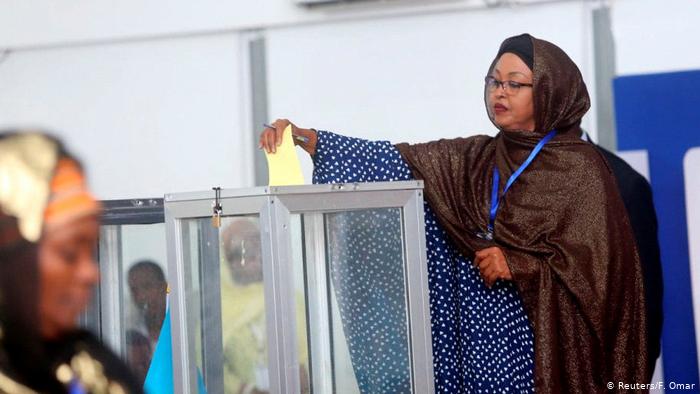
The mission supported the indirect parliamentary and presidential elections of 2016–2017, which resulted in the election of Mohamed Abdullahi Farmaajo as president.
Under Michael Keating, who succeeded Nicholas Kay in 2016, the mission provided political engagement and technical assistance during negotiations over the electoral framework.
UNSOM subsequently supported preparations for the 2020–2022 electoral process, which became prolonged by disagreements between federal and state leaders over electoral arrangements, implementation and political authority.
James Swan, who headed the mission from 2019 to 2022, was involved in diplomatic efforts to encourage political compromise during the electoral impasse.
The process eventually concluded with the election of Hassan Sheikh Mohamud for a second presidential term in May 2022.
Throughout this period, the mission also supported constitutional review, parliamentary development, electoral institutions and discussions over the distribution of powers between the federal government and member states.
However, Somalia’s constitutional and electoral arrangements remained contested, with successive governments and opposition groups disagreeing over the pace and direction of political reforms.
Political Tensions and the Expulsion of a UN Envoy
UNSOM’s engagement was not without controversy, particularly when its political interventions were viewed by Somali authorities as interference in domestic affairs.
The most prominent confrontation occurred in January 2019 when the federal government declared Nicholas Haysom, then the UN Secretary-General’s Special Representative for Somalia, persona non grata.
Haysom had questioned the circumstances surrounding the arrest of Mukhtar Robow, a former senior Al-Shabaab figure who was contesting the South West State presidential election in December 2018.
His inquiries also addressed the deaths of civilians during protests and the involvement of security forces in the electoral dispute.
The Somali government accused Haysom of exceeding his mandate and interfering in national affairs.
The United Nations rejected the legal basis of the persona non grata declaration, while Secretary-General António Guterres expressed confidence in his representative.
Haysom was subsequently replaced by James Swan.
The dispute highlighted the delicate relationship between the UN’s mandate to support political accountability and Somalia’s insistence on sovereignty over its internal political affairs.
Changing Leadership and Political Priorities
Over the 13-year period, the mission was led by several senior international diplomats whose tenures coincided with different phases of Somalia’s political transition.
Nicholas Kay oversaw its establishment and early federalisation efforts, while Michael Keating led engagement during the 2016–2017 electoral transition.
Nicholas Haysom’s brief tenure ended in the diplomatic dispute of 2019, after which James Swan assumed leadership during the prolonged 2020–2022 elections.
British diplomat Catriona Laing took over in 2023, overseeing engagement on constitutional reform, federal political relations and governance.
Swan returned in 2024 as the UN prepared to transform UNSOM into a transitional mission.
Raisedon Zenenga subsequently served as Officer-in-Charge during the final phase of UNTMIS.
From UNSOM to UNTMIS
In 2024, the federal government formally requested a transition away from UNSOM, arguing that Somalia’s political and institutional development required a different framework for cooperation with the United Nations.
The Security Council adopted Resolution 2753 in October 2024, replacing UNSOM with UNTMIS effective November 1.
Unlike its predecessor, UNTMIS was designed as a temporary mechanism to transfer responsibilities to Somali institutions and the wider UN country team.
Its work focused on completing the handover of political advisory functions, constitutional and electoral support, governance assistance and related institutional responsibilities.
Security Council Resolution 2809, adopted in December 2025, established the framework for the mission’s final withdrawal by October 31, 2026.
At a ceremony in Mogadishu on October 26, senior Somali government officials, opposition leaders, diplomats and UN representatives reflected on the mission’s contribution to the country’s political development.
Among those attending were Deputy Prime Minister Salah Ahmed Jama, former President Sheikh Sharif Sheikh Ahmed and former Prime Minister Mohamed Hussein Roble.
An Unfinished State-Building Process
The closure comes as Somalia continues to confront many of the political questions that shaped UNSOM’s original mandate.
Although the federal system has expanded and national and regional institutions have developed, disagreements over constitutional authority, electoral arrangements and relations between Mogadishu and federal member states remain unresolved.
The mission’s departure also follows years of debate over the role of international actors in Somalia’s domestic political affairs, with successive governments seeking greater control over national decision-making.
For the United Nations, the transition represents the completion of a political mission that accompanied Somalia through the establishment of federal member states, successive electoral cycles and efforts to consolidate national institutions.
For Somalia, it marks the assumption of greater responsibility for managing political dialogue, constitutional development and relations between federal and regional authorities without a dedicated UN political mission.
The closure does not affect the UN’s wider presence in Somalia, including its humanitarian and development agencies and separately mandated security-support arrangements.
After 13 years, the end of UNSOM and its successor UNTMIS closes a significant chapter in Somalia’s post-transition political history, even as the state-building process that defined their mandates continues.