
Aden Abdulle’s Legacy: The Debt Successive Somali Governments Still Owe
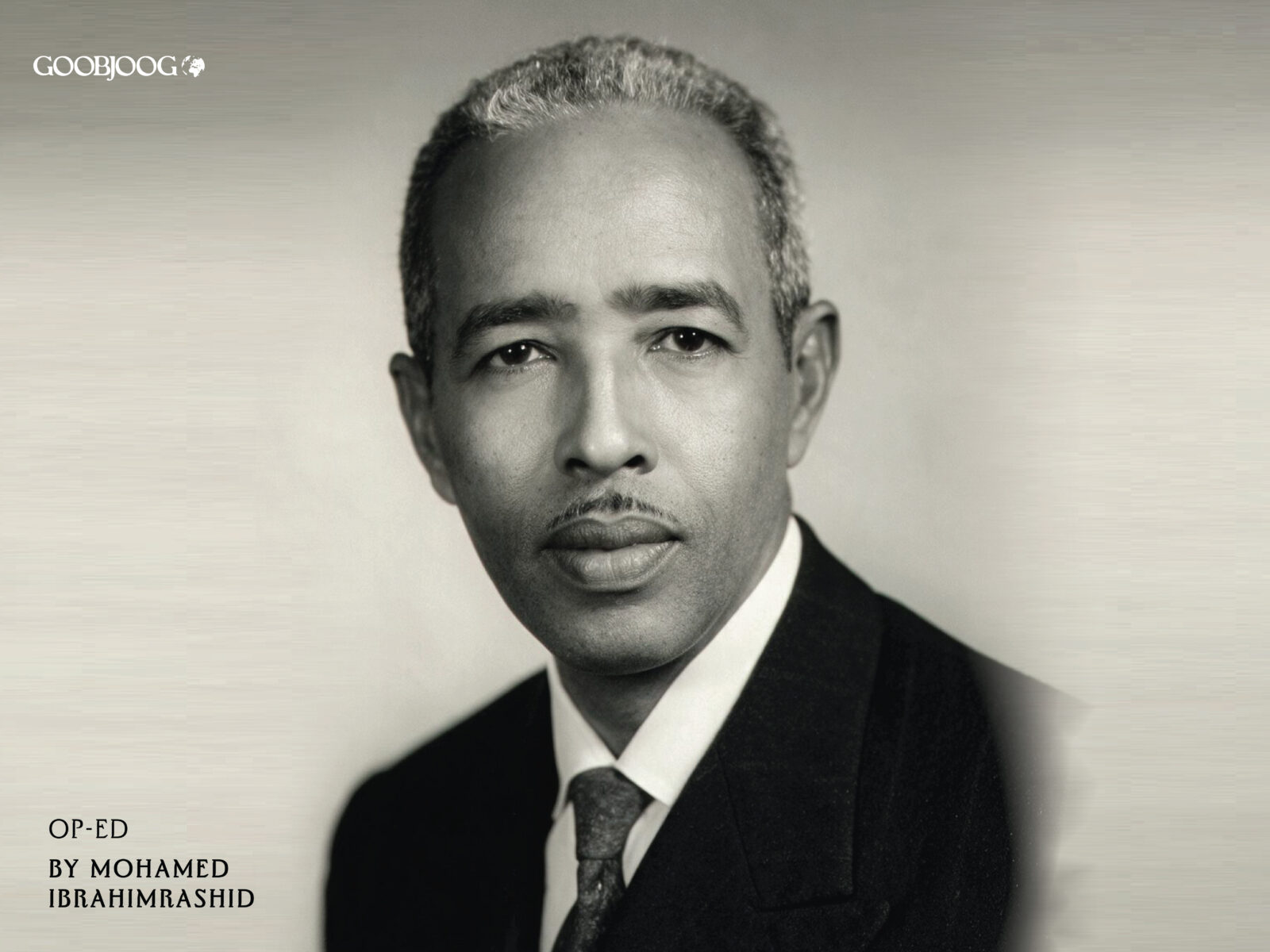
Aden Abdulle Osman, famously known as Aden Adde, was Somalia’s first president and the first African head of state to peacefully transfer power after losing a democratic election. He remains one of the most admired figures in Somalia’s political history, remembered for a standard of integrity that has rarely been matched.
His beginnings offered little reason to expect such a legacy. His mother died when he was young. His father was left permanently disabled after a lion attack, forcing Aden into child labor. He grew up under Italian colonial rule, where intimidation and discrimination were part of everyday life. Many political leaders have later invoked personal hardship to excuse the abuse of power. Aden never did. Instead, his public life was marked by restraint and keen diplomacy, qualities that first distinguished him in Somalia’s independence movement and later carried him to the presidency, where he served from 1960 to 1967.
By conventional standards, Aden enjoyed little formal education. He neither received advanced Islamic scholarship nor passed through the limited colonial schools designed primarily to produce low-ranking administrators. Yet his public life demonstrated a moral clarity that formal institutions alone cannot manufacture.
That conduct was most visible at the end of his presidency. He declined to campaign for another term, opposed a proposed parliamentary salary increase of twenty-four thousand Somali shillings per member, and, after losing the election, requested to leave office early so that his successor could preside over Independence Day celebrations. He then returned quietly to his farm.
Today, politicians whose public records bear little resemblance to Aden’s routinely invoke him as their model. In doing so, they diminish, rather than honour, the legacy of the man they claim to admire.
Successive governments have also struggled to honor him in ways equal to his stature. Following his death in June 2007, former president Abdullahi Yusuf Ahmed’s Transitional Federal Government declared twenty-one days of national mourning and renamed Mogadishu’s international airport after him in his honor. Former president Mohamed Abdullahi Farmajo later displayed Adam’s portraits in Villa Somalia’s diplomatic corridor, and a documentary on Aden’s life also appeared during his presidency.
Good intentions, however, have too often been undermined by poor execution. The airport that bears his name has become associated with political exclusion, weak governance, and institutional dysfunction rather than national excellence. The cartoonist commissioned by Farmajo’s staff was a foul-mouthed figure whose work drew rebuke. The portraits were later removed by successive administrations and have never been replaced with a memorial befitting president Aden Adde’s stature.
Individual efforts and private initiatives have often done more to preserve Aden’s memory than the state itself. Medical facilities bearing his name in Mogadishu are among the private efforts to maintain recognition of his legacy. Somali writers and historians, including Mohamed Issa Trunji, whose book Aden Abdulla: His Life and Legacy draws on Aden’s handwritten notes and materials gathered from foreign archives, have also contributed to documenting his life and preserving a foundational chapter of Somali history.
It is unfortunate that the responsibility for preserving President Aden Abdulla’s legacy has fallen largely on individuals who have shouldered a burden that rightly belongs to the nation as a whole. A nation cannot outsource its historical memory.
Aden peacefully transferred power after an electoral defeat in 1967, becoming the first African president to do so through a democratic election. At a time when military juntas gripped Latin America, when Portugal and Spain remained under authoritarian rule, and when Greece fell to a colonels’ coup, his peaceful departure was not merely an African first—it was a global anomaly. Thirteen years later, Léopold Sédar Senghor voluntarily stepped down after two decades in office, constitutionally handing power to his prime minister, Abdou Diouf—who would himself govern Senegal for nearly another two decades. Today, Senghor’s legacy occupies a far more prominent place in international scholarship and public memory than Aden Abdulla’s earlier democratic achievement. Senegal invested in preserving its democratic inheritance while Somalia neglected its own.
Aden’s life should not exist only in speeches, airport signage, or fading portraits. It should be studied systematically in schools and higher education institutions as a case study in democratic leadership, constitutional restraint, and ethical public service. Aden’s personal integrity was extraordinary, but no democracy can depend on the character of one individual alone. It requires institutions strong enough to survive the departure of even its most principled leaders. Had stronger civic institutions existed during Somalia’s formative years, they might have reinforced the democratic culture that Aden Abdulla represented and strengthened the resilience of the young republic before the rupture of 1969.
Aden’s integrity deserves institutions that preserve democratic memory, including a presidential library, a museum dedicated to Somalia’s constitutional history, a permanent national prize for ethical leadership, a Somali research centre devoted to democratic governance, or even a future strategic resource project bearing his name.
Aden Abdulle Osman himself asked little of his country. Somalia, however, owes much to his example. Until Somalia builds institutions worthy of the president who surrendered power with dignity, every invocation of Aden’s name will serve less as a tribute than as a reminder of how far the republic still stands from his example.