
Polls Boss Announces Direct Elections in S.West Upon Arrival in Baidoa
GOOBJOOG NEWS|BAIDOA: South West State is preparing to hold parliamentary and district council elections on the 28th of this month, in what is shaping up to be one of the most consequential political transitions in the region’s recent history.
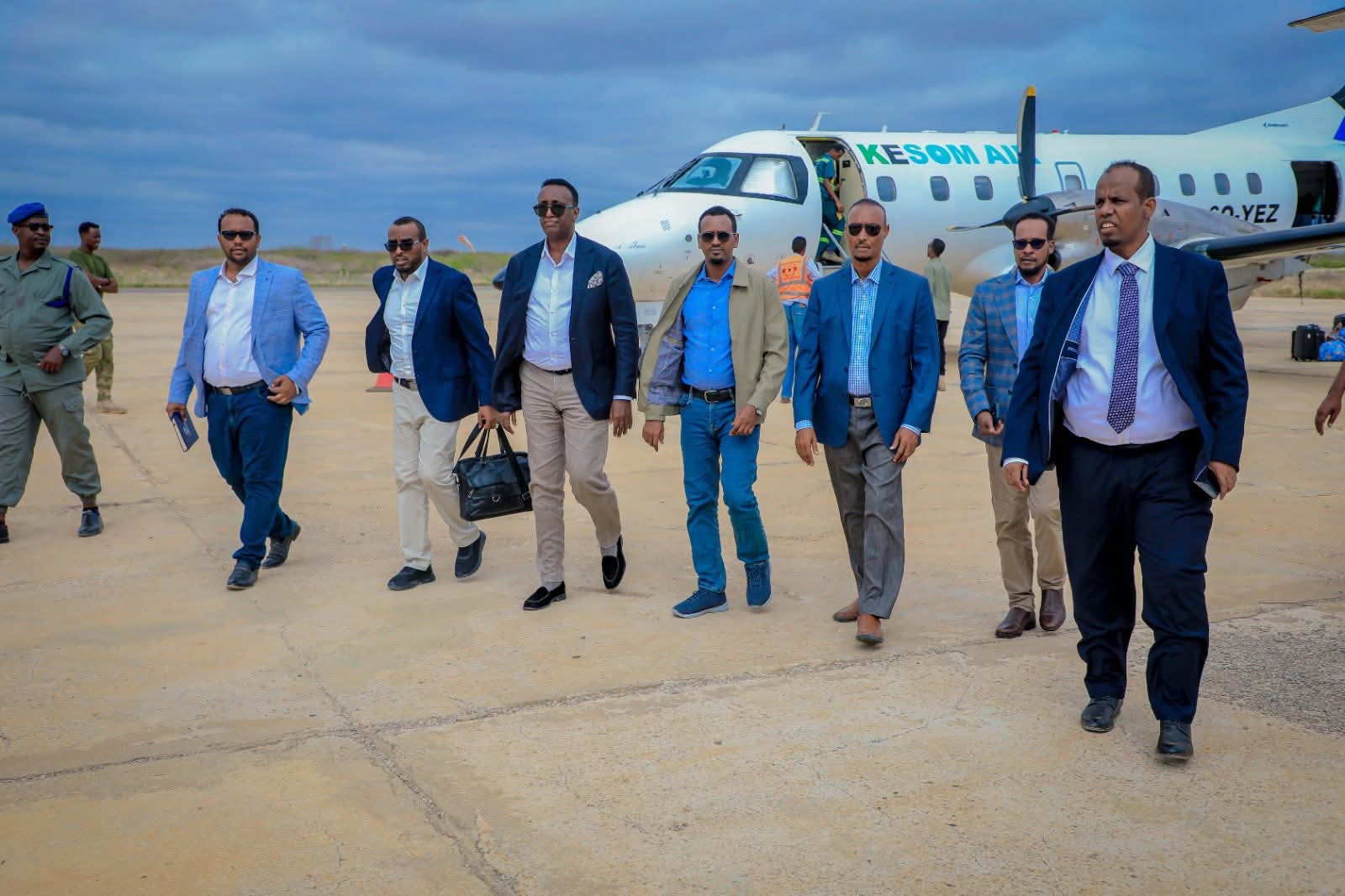
The Chairperson of the National Electoral Commission Abdikarin Hassan confirmed that all preparations have been completed, with authorities pledging adequate security and safeguards to ensure a free, fair, and transparent vote. He announced the electoral exercise upon arrival in Baidoa Monday afternoon.
The elections will be conducted under a one-person-one-vote system, allowing citizens to directly elect members of the state parliament and district councils simultaneously—marking a significant departure from Somalia’s traditional indirect electoral model.
While Puntland has previously implemented one-person-one-vote elections, particularly at the local level, South West’s process stands out for its scale and political implications. Notably, it is expected to lay the groundwork for the direct election of the state president, a move that could fundamentally reshape political legitimacy and competition within the state.
Leadership Crisis And Political Reset
The upcoming elections follow a period of political turbulence, including the controversial and forced resignation of Abdulaziz Hassan Mohamed Laftagareen.
Laftagareen had only recently been re-elected by the South West State Assembly under the indirect system before being pushed out amid mounting political pressure and federal intervention. His removal triggered sharp debate among political stakeholders, with critics questioning the legality and timing of the move, while supporters argued it created an opportunity to reset the state’s political trajectory through direct elections.
The leadership vacuum that followed has accelerated the shift toward universal suffrage, positioning the upcoming vote as both a democratic exercise and a mechanism to resolve political tensions.
Federal Engagement And Reform Push
The developments come alongside increased federal involvement, highlighted by a recent visit to Baidoa by Hassan Sheikh Mohamud. During the visit, the president held consultations with regional officials, elders, and community leaders, focusing on reconciliation, stabilization, and the transition toward a more inclusive electoral system.
Observers see the federal government’s engagement as part of a broader effort to push Somalia toward full democratization, particularly in federal member states where indirect elections have long dominated.
A High-Stakes Democratic Test
The simultaneous election of parliamentarians and local councils presents both an opportunity and a logistical challenge. Analysts point to risks including security threats, the integrity of voter registration, and the need for credible dispute resolution mechanisms.
However, for many residents, the elections represent a historic opportunity to directly choose their leaders for the first time at both local and state levels.
If successful, South West could set a new benchmark for electoral reform in Somalia—not as the first to adopt one-person-one-vote, but as a state attempting to extend it further, potentially to the direct election of its president.
As the 28th approaches, attention is firmly fixed on Baidoa, where the outcome of this process could have lasting implications for Somalia’s democratic future.