
The Fryer’s Delusion: Why Mogadishu’s Copycat Economy is Selling a Dream That Doesn’t Exist
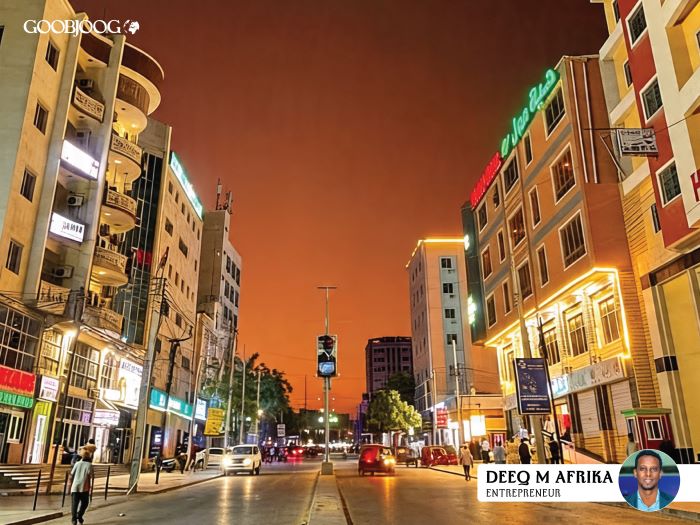
By Deeq M Afrika
Mogadishu’s Taleex district is a place where hope smells like diesel and hot oil. But recently, I watched that hope curdle in the time it takes to heat a fryer—another casualty of a market that has run out of room.
It started with Shukri. She’s one of the reliable ones in our kitchen, earning a steady $300 a month, enough to keep the lights on and the kids fed. Last year, her friend Yasmin tried to stage a mutiny. “Quit the kitchen,” Yasmin urged. “Start a stall. Be your own boss.”
Shukri stayed, Yasmin left. By August 2025, Yasmin was one of six women who had set up identical stalls on the same stretch of pavement, all selling the same thing: loaded fries and chicken. They were all solo breadwinners, and they were all chasing a $1,000-a-month “clean profit” promise that someone, somewhere, had whispered in their ears.
I caught up with them again late February 2026. The pavement was empty. All six stalls were gone.
The story of those six women isn’t just a local tragedy; it’s a symptom of a copycat epidemic that is currently cannibalizing the Somali economy.
The Saturation Paradox
If you’ve ever sat through an Econ 101 lecture, you know how supply and demand are supposed to work. When the market is flooded, prices drop to attract customers. But Mogadishu isn’t a textbook; it’s a gauntlet.
Here, we have “saturation without competition.” If one person finds success selling a specific Abaya, ten people will open the exact same shop on the same block. But prices don’t go down. They can’t. The overheads are so punishing that dropping prices by even a dollar is a suicide mission.
The Math of Failure: Imagine a total market of 100 customers. A single shop needs 15 customers a day just to pay the rent and 20 to actually make a cent of profit. When five identical shops open next door, the market doesn’t grow; it just divides. Suddenly, everyone is averaging 12 customers a day.
Everyone starves, yet everyone keeps their prices high because the “cost of existing” in this city, the rent, the electricity, the “fees”—is relentless.
The “Malls of FOMO”
We’re seeing a new, cynical trend in real estate. Developers are carving up buildings into 20 or 30 tiny, 50sqm boxes and calling them “malls.” It’s a brilliant way to harvest the Fear Of Missing Out (FOMO) from young, unemployed people.
My wife recently spoke to a friend who wanted to open a clothing store on our street. The “entry fee” was staggering:
- Rent: $1,000 a month (with 6 to 12 months demanded upfront).
- Sunk Costs: $25,000 for the fit-out and initial inventory.
When my wife sat her down and showed her a projection where she might lose money for the first quarter, the friend looked like she’d been slapped. She wasn’t prepared for a business; she’d been sold a lottery ticket.
The Survival Reality
The global data for small businesses is already a horror show, even in stable markets. According to the 2026 Business Survival Index, about 20% of new ventures fail within the first year, and that number climbs to 50% by year five.
But in Somalia, we are fast-tracking this. We don’t have the luxury of “market research” we have “look what my neighbor is doing.”
I remember back in 2021 when our restaurant (Milgo) was just open for almost a year, a friend come to me, his eyes bright with the prospect of opening a coffee shop.
I asked him, “have you done some research”?
“Look at Beydan,” he told me, pointing at their bustling counter. “They’re moving 200 cups a day at $2.50. Even on a bad day, I could surely do 150.”
I couldn’t help but laugh. “Are you really counting the cash in someone else’s pocket and calling it your business plan?”
That is the Somali trap in a nutshell. People see the revenue, but they are blind to the operations behind it. They see the queue at the door, but they don’t see the years of frustration, the sacrifices to built trust, the brutal operational grind, or the specific magic of that location. Success leaves clues, sure, but it doesn’t provide a “copy-paste” formula. In Mogadishu, we build businesses on assumptions, and in this economy, assumptions are the quickest way to go broke.
The High Cost of “Freedom”
The four ladies who left the restaurant job for the fry-stalls learned a bitter lesson about the “autonomy” of entrepreneurship. As employees, they worked eight hours, got paid, and went home to their children.
As “owners,” they were hit by the reality of:
- Invisible Labor: The peeling, the chopping, the scrubbing.
- The Safety Net: If the road is closed or you’re too sick to stand, you don’t get paid. There is no sick leave when you are the boss of an empty stall.
- The Tax Trap: Everything in Somalia is imported. An item bought for $10 in China ends up costing $25 after the government takes its “arm and a leg” in duties and taxes.
Add the world’s most expensive electricity to that $25 base cost, and suddenly that $50 price tag on an Abaaya isn’t “greed”….it’s a desperate gasp for air.
A Note to the Business Community and the Government
To the Business Community: Stop building boxes and calling them malls. We don’t need the 40th boutique selling the same dresses. We need cold storage, manufacturing, and logistics. We need a reason for people to shop, not more places for them to go bust.
To the Government: Your tax structure is currently an anti-entrepreneurship program. When you punish importers with astronomical fees, you aren’t just taxing goods, you are taxing the survival of the youth.
The six ladies of Taleex are back to square one, looking for the very jobs they were told were beneath them. Let their story be a warning: A business built on a copy-paste strategy isn’t an investment…it’s an expensive way to go broke.
Goobjoog News is committed to publishing a diversity of letters to the editor or any other article of interest to our readers. We’d be glad to hear what you think about this article or any other article in our opinion sections.
Deeq M Afrika is an entrepreneur based in Mogadishu