
UN Says Closure of Somalia Political Mission Will Not End Cooperation
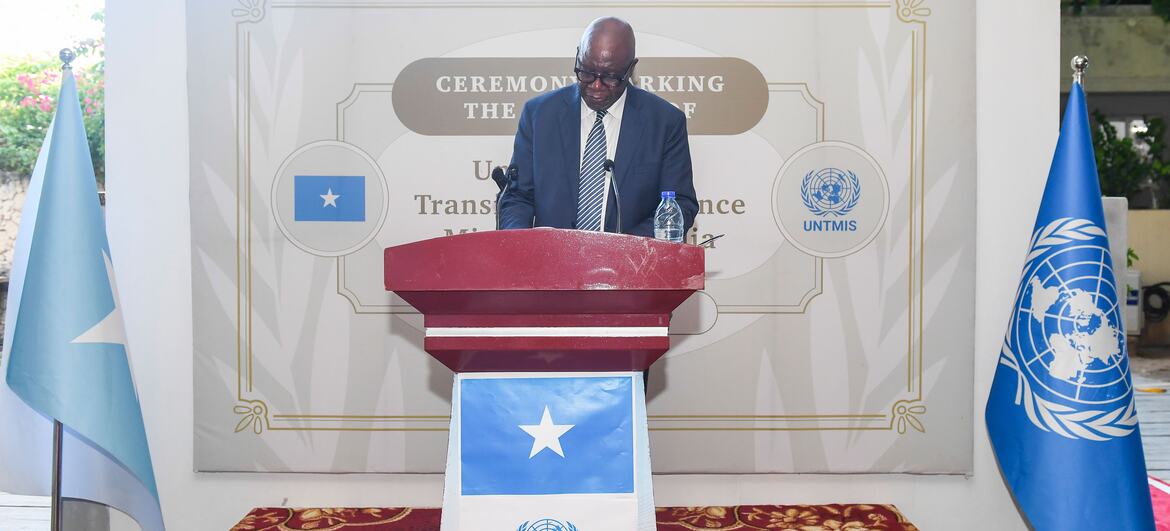
GOOBJOOG NEWS | MOGADISHU: The United Nations has assured Somalia that the closure of its political mission will not end cooperation between the two sides, describing the development as a transition to a new phase of partnership after more than three decades of political engagement in the country.
Speaking at the conclusion of the mission, Raisedon Zenenga, the UN Secretary-General’s Deputy Special Representative for Somalia and Officer-in-Charge of the United Nations Transitional Assistance Mission in Somalia (UNTMIS), said the closure marked a change in the relationship rather than an end to cooperation.
“Today is not an end to the partnership between the United Nations and Somalia—rather, it marks the conclusion of one chapter and the beginning of another,” Zenenga said.
The closure brings to an end the UN’s dedicated political mission in Somalia, which has supported the country through successive periods of conflict, political transition and state-building.
The UN’s political engagement dates back to 1995, when the United Nations Political Office for Somalia (UNPOS) was established. It was replaced by the United Nations Assistance Mission in Somalia (UNSOM) in 2013, which was later succeeded by UNTMIS in 2024 as part of a phased transition towards greater Somali ownership of political and institutional responsibilities.
The transition has involved gradually transferring responsibilities previously handled by the political mission to Somali government institutions, other UN agencies and international partners.
However, the closure does not amount to a complete UN withdrawal from Somalia. UN agencies, funds and programmes will continue supporting humanitarian operations, development priorities and other areas of cooperation, while the United Nations Support Office in Somalia (UNSOS) will maintain its role in providing support to the African Union-led security mission.
The change comes as Somalia continues to face significant challenges, including the fight against Al-Shabaab, political disagreements over constitutional and electoral arrangements, humanitarian pressures caused by recurrent droughts and floods, and the need to strengthen public institutions.
The end of the political mission marks another stage in efforts by the federal government of Somalia to assume greater responsibility for the country’s political processes and national priorities, while maintaining cooperation with international partners.
Zenenga’s remarks sought to underline that the end of the mission should not be interpreted as a retreat by the United Nations, but as a shift in the way its partnership with Somalia will be organised.
The next phase will place greater emphasis on cooperation through Somali institutions and the UN’s wider country presence, as Somalia continues its efforts to consolidate state institutions and address long-standing security and development challenges.