
Arrests, Road Closures Disrupt Kenya as Saba Saba Protests Spread Across Major Cities
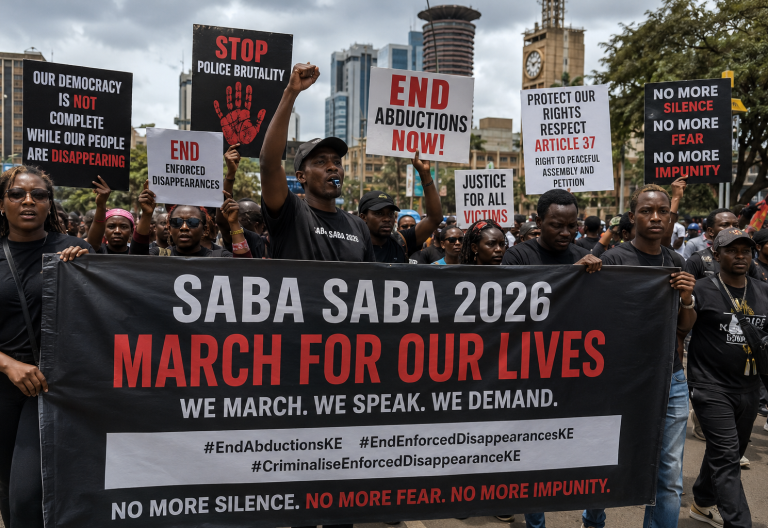
GOOBJOOG NEWS|NAIROBI: Businesses remained shuttered and transport was severely disrupted across Kenya on Monday as Saba Saba demonstrations spread through Nairobi, Mombasa, Kisumu, Nakuru, Eldoret and several other towns, prompting a heavy police deployment, widespread road closures and dozens of arrests.
Major highways leading into Nairobi’s central business district were barricaded, while security officers established roadblocks at key entry points, forcing many commuters to abandon their journeys and keeping thousands of workers away from their workplaces.
The impact was felt well beyond the capital. In Mombasa, Kisumu, Nakuru and Eldoret, businesses remained closed as protesters took to the streets demanding greater government accountability, an end to alleged police brutality, action against corruption and improved economic conditions. Schools, public transport services and commercial activities were disrupted in several counties as authorities sought to contain the demonstrations.
The nationwide protests underscored how Saba Saba has evolved from a remembrance of Kenya’s historic struggle for multiparty democracy into an annual platform for citizens to voice concerns over governance, economic hardship and constitutional freedoms.
Origins of Saba Saba
“Saba Saba,” meaning “Seven Seven” in Swahili, traces its origins to July 7, 1990, when opposition leaders and pro-democracy activists called for a rally at Nairobi’s Kamukunji Grounds to demand the restoration of multiparty democracy, constitutional reforms and greater political freedoms under the one-party rule of President Daniel arap Moi.
Although leading opposition figures Kenneth Matiba and Charles Rubia were arrested before the rally, thousands of Kenyans defied the ban and demonstrated. The protests were violently suppressed, but they became a turning point in Kenya’s democratic struggle, eventually leading to the repeal of Section 2A of the Constitution in 1991 and the return of multiparty politics.
More than three decades later, Saba Saba remains one of Kenya’s most significant political anniversaries. What began as a campaign for political pluralism has grown into a broader movement advocating accountable leadership, respect for human rights, constitutional freedoms and economic justice.
The emergence of the Gen Z-led protests in 2024 gave the annual commemoration renewed significance. Initially sparked by opposition to the Finance Bill, the demonstrations quickly evolved into a wider campaign against corruption, police brutality, unemployment and poor governance. Since then, Saba Saba has increasingly become a rallying point for a younger generation seeking to expand the democratic space secured by those who took to the streets in 1990.