
JSP’s Galmudug Victory Extends President Mohamud’s Political Reach Across Somalia
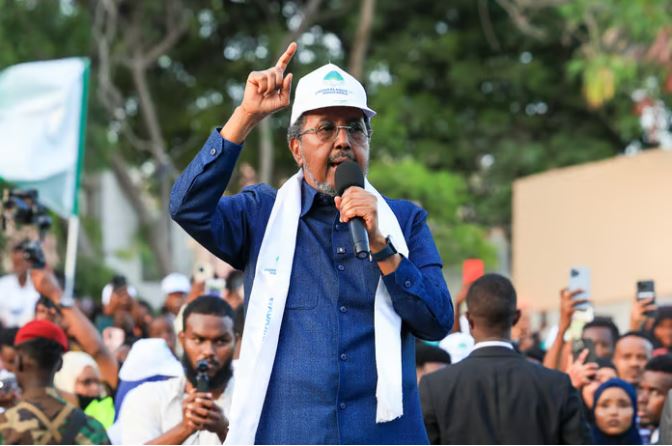
GOOBJOOG NEWS|DHUSAMAREB: The Justice and Solidarity Party’s commanding victory in Galmudug has strengthened President Hassan Sheikh Mohamud’s political position as Somalia approaches an increasingly contested national presidential election.
According to results released following elections in 11 Galmudug towns and cities, JSP won 63 seats—nearly three-quarters of the 87 seats secured by the five represented parties. Towfiiq finished a distant second with 12 seats, followed by Sincad with six, Karaama with five and Ramaas with one.
Sixteen political parties participated in the elections. The commission said Galmudug had 247,000 registered voters and that close to 198,000 ballots were cast.
The scale of the victory matters beyond Galmudug. It is the latest evidence that JSP is building a formidable political network across several federal member states and the capital, potentially giving President Mohamud an important institutional advantage ahead of the national contest.
A pattern of JSP dominance
Galmudug has followed a pattern established first in Banaadir and then in South West State.
In Banaadir’s municipal elections, JSP won 177 of the 390 local council seats. Towfiiq secured 49, Ramaas 42, Karaama 39 and Sincad 26, while the remaining parties shared 57 seats. JSP received approximately 46 percent of the vote, making it by far the largest party in the capital’s new local councils. The results were subsequently ratified by Somalia’s Supreme Court.
The Banaadir result, however, remains politically contested. Leading national opposition groups boycotted the election, arguing that the process lacked a sufficiently inclusive political agreement and was being managed in a way that favoured the incumbent administration.
The opposition has since extended that criticism to the elections being conducted in the federal member states. Its leaders describe the wider process as compromised and designed to consolidate JSP’s control ahead of the national presidential election. The federal government rejects those claims and presents the elections as part of Somalia’s transition from negotiated, clan-based representation to direct voting.
JSP consolidated its momentum in South West State in May. It won 51 of the 95 contested House of Representatives seats after receiving 67,970 votes—about 53 percent of valid ballots. The National Progress and Unity Party placed second with 14 seats, while Karaama won 11.
In the parallel South West local council elections, JSP captured 148 of 297 seats. This gave the party control of almost half the council positions and placed it well ahead of every rival organization.
Taken together, the three results reveal an emerging electoral structure: JSP is establishing itself as the only party with a substantial and organized presence across multiple regions. Its rivals remain divided, with no single opposition party consistently finishing second or demonstrating a comparable national reach.
At the same time, the opposition boycott complicates attempts to interpret JSP’s victories purely as a measure of nationwide popular support. The results demonstrate the party’s organizational strength and its dominance within the electoral process, but they have not settled the wider dispute over the process’s inclusivity and political legitimacy.
Galmudug presidency now within JSP’s reach
The Galmudug result will directly shape the state’s forthcoming presidential election.
Under the federal member state political system, members of the state assembly elect the president. JSP’s control of 63 seats therefore gives it an overwhelming majority in the body that will choose Galmudug’s next leader.
The party should have sufficient votes to elect its preferred candidate without relying on opposition support. Barring significant internal defections or an unexpected breakdown in party discipline, the JSP candidate is overwhelmingly positioned to become the next president of Galmudug.
JSP has been promoting Liibaan Ahmed Hassan as its Galmudug leadership candidate. His campaign has already received support from senior federal and regional officials associated with the party.
His expected election would give JSP control of both the Galmudug legislature and presidency, further integrating the state into President Mohamud’s expanding political coalition.
Building power from the regions upward
JSP’s strategy appears to be constructing national influence from the local and state levels upward.
Winning local councils gives the party grassroots representatives, district-level organization and access to emerging political leaders. Controlling state assemblies increases its influence over regional legislation and, because those assemblies elect state presidents, gives the party a pathway to controlling regional executives.
Securing allied state presidents could, in turn, provide President Mohamud with influential partners during negotiations over the national electoral framework and the eventual selection of Somalia’s next president.
This matters especially because the method and timetable for the national election remain disputed. The federal government is advancing a one-person, one-vote system, but opposition leaders and the administrations of Puntland and Jubaland have challenged important aspects of the process.
The opposition argues that elections conducted without a comprehensive national agreement cannot provide a neutral foundation for the presidential contest. It maintains that the process is structured to entrench the incumbent and expand JSP’s institutional control before the rules governing the national election have been agreed.
The government denies that the process is partisan. It says direct elections are necessary to return political power to citizens and move Somalia away from a system in which clan delegates and political elites determine representation.
That disagreement creates two competing interpretations of JSP’s rise. Supporters see the party’s victories as evidence of organization, voter confidence and the emergence of national party politics. Critics see them as the predictable outcome of an electoral process controlled by an incumbent whose principal opponents have declined to participate.
A growing advantage ahead of the national contest
JSP’s regional victories do not automatically translate into President Mohamud’s re-election. The outcome will depend on the final national electoral model, the participation of opposition-controlled states, the credibility of the process and whether a broader political settlement can be reached.
Nevertheless, the direction of political power is becoming clearer. JSP now possesses significant representation in Banaadir and South West, has secured an overwhelming Galmudug assembly majority and is strongly positioned to capture the Galmudug presidency.
If it reproduces this performance in forthcoming elections elsewhere, JSP could enter the national contest with an organizational and institutional advantage unmatched by any rival party.
For President Mohamud, Galmudug is therefore more than another regional victory. It is another building block in a widening political structure that could prove decisive when Somalia’s struggle over the presidency reaches its final stage.
For the opposition, however, the same result will reinforce its claim that the contest is being decided incrementally—through disputed regional processes—before an inclusive national electoral agreement has been reached.