
Somali Journalists Face Rising Threats, With Women Targeted on a Second Front, Report Says
GOOBJOOG NEWS|MOGADISHU: Journalists across Somalia are facing rising threats both on the streets and online, with women reporters subjected to an added layer of gender-based abuse and pressure, a new report by the Somali Media Women Association (SOMWA) says.
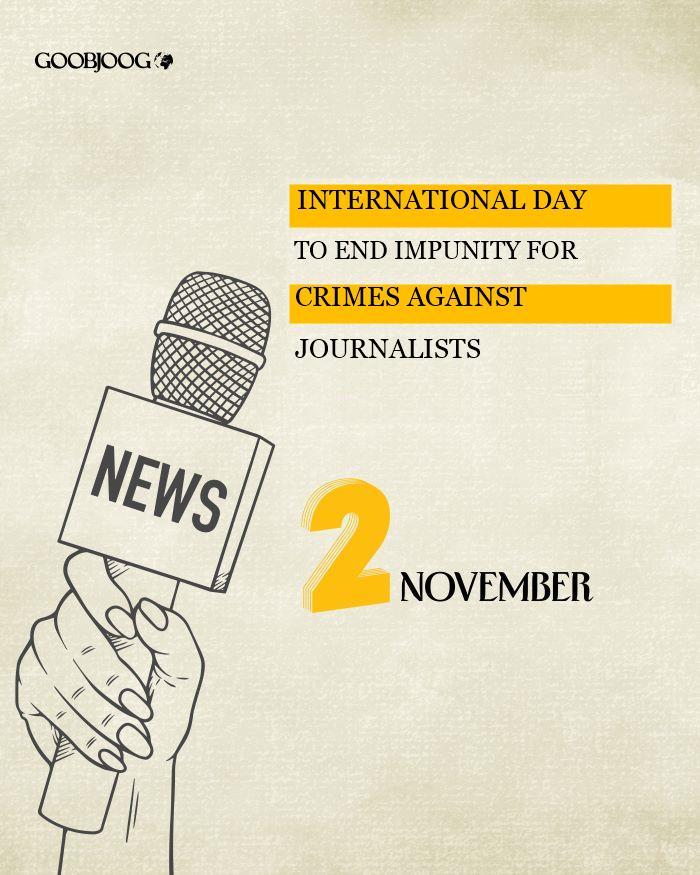
The report documents 96 incidents of violations against journalists between November 2025 and October 2026, affecting more than 30 journalists and disrupting or shutting down two media houses. It was released to coincide with the International Day to End Impunity for Crimes Against Journalists.
Arrests and detentions were the most frequently recorded violations, with 33 cases. SOMWA also counted 21 digital attacks, 17 physical assaults, 13 abductions and 12 cases in which security forces seized journalists’ equipment.
Mogadishu’s Banadir region accounted for 38 incidents, the highest number in any region. The report also recorded 24 cases of arbitrary detention in Puntland. March and July were identified as the period’s most dangerous months.
Attacks move online
SOMWA says social media platforms have become another means of silencing journalists. It describes coordinated networks submitting false copyright claims to disable popular news channels, and forged death documents being used to exploit Facebook’s memorialisation process and lock living journalists out of their accounts.
Among the cases cited is that of Munasar Mohamed, an exiled journalist with more than two million Facebook followers. In September 2026, the report says, coordinated accounts used forged documents in an attempt to have his account memorialised.
Other journalists and media figures named in the report include Farah Geylan of Geylan Media and Abdirisak Atosh of Salbaar Media, whose large Facebook pages were targeted in a wave of disabling attacks on September 14. Hasan Gallaydh and Ismail Shine had their accounts disabled on October 24, while Sharma Hiilwalaal and Shiine Culey experienced repeated page disablements in September and October.
Women face additional pressure
SOMWA says women journalists face a distinct layer of retaliation, including sexualised online abuse, character attacks and pressure within their families and communities. The association has tracked 79 gender-based violations since 2023.
The report says personal attacks are often launched soon after women publish critical stories, adding social pressure to the risks they already face as journalists. It also describes an unequal aftermath of detention: women may return home to scrutiny of their reputation and career, as well as concerns about their safety.
Several cases illustrate the risks. Rowda Hassan Taakilo of Goobjoog Media was detained in Mogadishu’s Deyniile district on May 7, 2026. SOMWA says her whereabouts were unknown to colleagues and family for a period, limiting their ability to seek help.
Suways Gacayte was arrested by Puntland security forces on July 2 and held at Garowe Central Prison for 13 days before being released on bail on July 15, according to the report.
SOMWA documents 96 incidents of violations against journalists, including arrests, assaults and coordinated attacks on social media accounts
Shukri Abdi, also identified as Shukri Caabi Abdi, of Shabelle Radio and TV was arrested and assaulted in Mogadishu’s Xamar Jajab district on May 7. On August 13, the report says, two mobile police officers assaulted her while she was covering a protest in the Abdicasiis district, seized her phone and left her needing hospital treatment for a hand injury.
The report also records the deaths of two journalists. Bashir Mohamed Abdullahi, known as Bashir Moalin, a 24-year-old Arlaadi Media Network reporter, was shot near his home in Baidoa on September 3 during armed clashes and died of his injuries four days later. Veteran journalist Mohamed Aweys Muudey, 68, who lived in exile, was fatally stabbed in Darmstadt, Germany, on September 18.
Calls for action
SOMWA is urging Somalia’s federal government to issue a written directive barring the Somali National Army, police and National Intelligence and Security Agency from arresting journalists at reporting scenes. It also calls for an independent body to handle complaints against security agencies.
The association is asking Meta to create a fast-track, human-reviewed verification channel for Somali media houses and add safeguards against false memorialisation requests and malicious copyright claims.
It is also calling on international partners to make press freedom a formal benchmark in governance and state-building discussions with Somali authorities.
The cases in the report span arrests at bombings and accidents, assaults while covering protests, abductions and online account attacks. Taken together, SOMWA’s findings portray a media environment where reporting can expose journalists to pressure from both state and non-state actors—and where women may face additional personal and social retaliation.