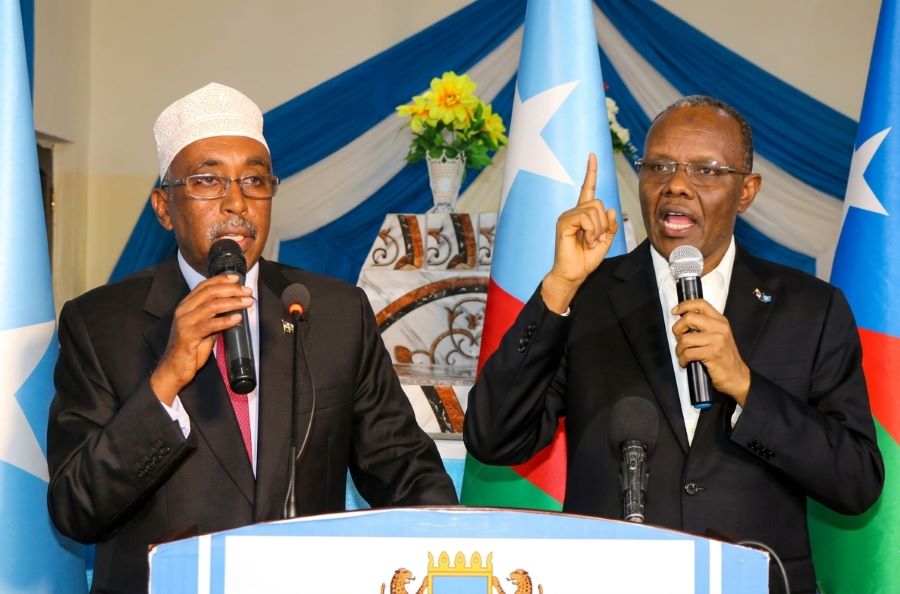
Poetic Justice: Laftagareen rose to power on the ruins of his predecessor’s forced exit. Eight years later, history handed him the same fate.
INTRODUCTION
There is a particular cruelty in Somali political theatre that reserves its sharpest lessons for those who benefit from it most. When South West State President Abdiaziz Hassan Mohamed Laftagareen posted his resignation notice on Facebook on the evening of March 30, 2026 — hours after federal government troops and armed groups aligned with regional opposition figures entered Baidoa following heavy fighting that left at least two people dead and 25 wounded — he became the latest victim of a playbook he once watched from the inside. More than that: he was a playbook he had once helped to run.
Because the last time a South West State president was forced from power in Baidoa under federal pressure, the man waiting in the wings to take the seat was Abdiaziz Laftagareen himself.
To understand Monday’s resignation is to travel back to December 2018, to another leader, another manufactured crisis, and another forced exit — and to ask the uncomfortable question that Somali politics has now answered with brutal precision: what happens when the instrument of someone else’s removal eventually becomes the target?
ACT ONE: HOW SAKIN FELL (2018)
By mid-2018, South West State President Sharif Hassan Sheikh Adan — widely known by his nickname “Sakin” — had become the most consequential thorn in President Mohamed Abdullahi Farmaajo’s side. A veteran political operator who had served as Speaker of the Federal Parliament and Finance Minister, Sakin had built South West State into an assertive power base that openly challenged Mogadishu. He belonged to a constellation of assertive regional leaders who were beginning to push back against Mogadishu’s demands.
The Federal Government’s strategy to dislodge him was not frontal — it was surgical. Rather than deploy troops, Farmaajo’s administration weaponised the electoral process itself. The Federal Government encouraged former Al-Shabaab deputy leader Mukhtar Robow to run for president of South West State in late 2017, but its interest was immediate — to destroy the political fortunes of Sharif Hassan Sheikh Aden. Robow, a towering figure among the Rahanweyn clan that dominates South West, received ‘a wink and a nod’ from Mogadishu. The plan: use Robow’s enormous local popularity to frighten Sakin off the ballot.
The same centralising impulse, now under Hassan Sheikh Mohamud, has produced a more explosive outcome in 2026, with federal troops now physically controlling Baidoa.
It worked. On the afternoon of November 17, 2018, Sakin announced his resignation as president of Southwest regional State, citing the interest of the country, his people and the Federal Member State, amid increasing pressure and interference by Somalia’s Central Government. Shortly before his announcement, the regional electoral commission also quit in unclear circumstances. Critically, no federal soldiers entered Baidoa. The pressure was political, institutional, and psychological — but devastating all the same.
What followed was the truly dark chapter. In hindsight, it became clear that the Federal Government never intended to welcome Robow into the Somali polity. Having used Robow to neutralise Sakin, Mogadishu then turned on Robow himself. Robow was arrested on 13 December, only days before the election, which automatically disqualified him from standing — leaving the way open for Farmaajo’s favoured candidate to win. From 13 to 15 December 2018, Federal Government and regional Somali security forces responded to public protests in Baidoa with lethal force, resulting in 15 civilian deaths. So charged was the situation that then UN Chief in the country Nicholas Haysom would be expelled two weeks later for questioning the arrest of Robow and calling for a probe into civilian killings by government forces.
Goobjoog’s own contemporaneous reporting captured the full cynicism of the moment. As the newsroom’s December 20, 2018 analysis noted, Laftagareen — described then as “the real spanner boy of FGS” — had withdrawn from the race for speaker in April and was appointed Energy Minister, a position he served for barely six months before being instructed to resign to contest for the South West seat.
He was, in the plainest language, Farmaajo’s hand-picked installation. The same Goobjoog analysis concluded that the election of Laftagareen marked a major milestone in the one-and-a-half year hostilities between the two levels of government — ‘a big sigh for the FGS despite the cost on democracy, rule of law, lives and rights of the people of South West to a leader of own choice.’
What makes the Laftagareen story so poetically — and tragically — complete is that the man installed through Villa Somalia’s machinations eventually became Villa Somalia’s problem.
The rupture between Laftagareen and President Hassan Sheikh Mohamud’s administration built gradually, crystallising around the federal government’s controversial constitutional amendments extending the terms of federal institutions from four to five years. In March 2026, Laftagareen resigned as Deputy Chairman of Somalia’s ruling Justice and Solidarity Party, saying he could not support what he characterised as unconstitutional actions that weaken national unity. On 17 March 2026, South West State severed ties with the federal government over issues related to Somalia’s ongoing constitutional crisis. This was followed shortly by the resignation of the JSP Secretary General Abdirahman Odowaa who also cited similar grievances against the president. Time to stop the haemorrhage had come.
The arc from Sakin to LaftaGareen is a study in how Somalia’s federal experiment has functioned in practice versus on paper: regional autonomy has remained contingent on the tolerance of whoever sits in Villa Somalia.
The Federal Government’s response this time was not the subtle manipulation of 2018. It was military. Hundreds of federal troops, backed by allied clan militias, entered Baidoa. Clashes with regional forces broke out but were brief. The regional troops were quickly overwhelmed, with some retreating and others surrendering. Videos circulating on social media showed federal forces, including Turkish-trained elite units equipped with armoured personnel carriers, moving through the city’s main streets.
The resignation came just two days after the Southwest regional parliament re-elected Laftagareen as president for another term, a result immediately rejected by the federal government. He fled Baidoa, departing from Shaati Gaduud airport and heading to Nairobi, where he is expected to remain. Like Nicolás Maduro of Venezuela who was captured by US forces and flown to the US, Laftagareen too unceremoniously left Baidoa, the scene of a military confrontation to another country.
THE PARALLELS: A STRUCTURAL ANALYSIS
1. The trigger was always an election dispute. In 2018, Sakin’s determination to seek a second term was what set Farmaajo’s machinery in motion. In 2026, Laftagareen’s freshly-won re-election — which the federal government immediately declared illegal — was the proximate cause of the military intervention. In both cases, Villa Somalia refused to accept a South West State president who had renewed a popular mandate without Mogadishu’s blessing.
2. The method escalated, but the goal was identical. In 2018, the Federal Government under Farmaajo used political engineering — encouraging Robow, manipulating the electoral commission, and applying relentless institutional pressure — to force Sakin out without boots on the ground. In 2026, Hassan Sheikh Mohamud opted for direct military force. The escalation is significant: it shows a federal government more willing to abandon the pretense of constitutional process.
3. Both men publicly denied being coerced. Sakin, in his resignation statement, declared he was stepping down “without force or coercion.” Laftagareen’s resignation statement on Facebook likewise offered no elaboration of the pressures he faced. Both were technically voluntary departures made under conditions that left no genuine alternative.
4. Laftagareen’s role in Sakin’s fall is the central irony. As Goobjoog’s contemporaneous coverage documented, Laftagareen was not a bystander to the 2018 crisis — he was its beneficiary and instrument. By pulling Robow out of action, Villa Somalia installed its candidate, Abdiasis Lafta Gareen, then a minister, as President of South West State. The man who rose to power through federal manipulation of a South West election ultimately fell through that same federal power. The chair was never really his; it was always Mogadishu’s to give and take back.
5. The federalism question overshadows both episodes. As Goobjoog warned in December 2018, the FGS’s increasing control of federal member states presented an existential threat to the federalist model that Somalis chose as an alternative to unitary rule. Both Farmaajo and Khaire were described as centralists to the hilt — demonstrating an aversion for federalism which they believed denied them full exercise of power. The same centralising impulse, now under Hassan Sheikh Mohamud, has produced a more explosive outcome in 2026, with federal troops now physically controlling Baidoa.
CONCLUSION: THE BAIDOA CHAIR
South West State has now seen two consecutive presidents removed under federal pressure — one through political suffocation, one through military force. The arc from Sakin to LaftaGareen is a study in how Somalia’s federal experiment has functioned in practice versus on paper: regional autonomy has remained contingent on the tolerance of whoever sits in Villa Somalia.
While the federal government has secured a military victory, analysts warn that a more difficult challenge lies ahead — fostering meaningful reconciliation in a region deeply divided along clan lines, with those divisions exacerbated by repeated federal interventions and persistent disputes over regional authority.
The same warning could have been written in December 2018. That it remains equally applicable today tells you everything about the price of the Baidoa playbook.